Gadget Wisdom

Author: David Shanske

Registration time

2011-09-25 06:23:49

Website

https://david.shanske.com/

Email

david@shanske.com

All posts by David Shanske

2 Responses

MythTV Rig: Part 1 – The Backend

As part of the first of our multipart series, Better Know a MythTV configuration, we profile our MythTV Backend.

Our MythTV backend has gone through a lot of changes over the years. The first iteration was in a yellow server case on wheels. We went through a period of overbuilding, and the yellow version of the case was $17, the other colors were all closer to $100. We probably have a picture of that iteration somewhere, and will post it if it is ever found.

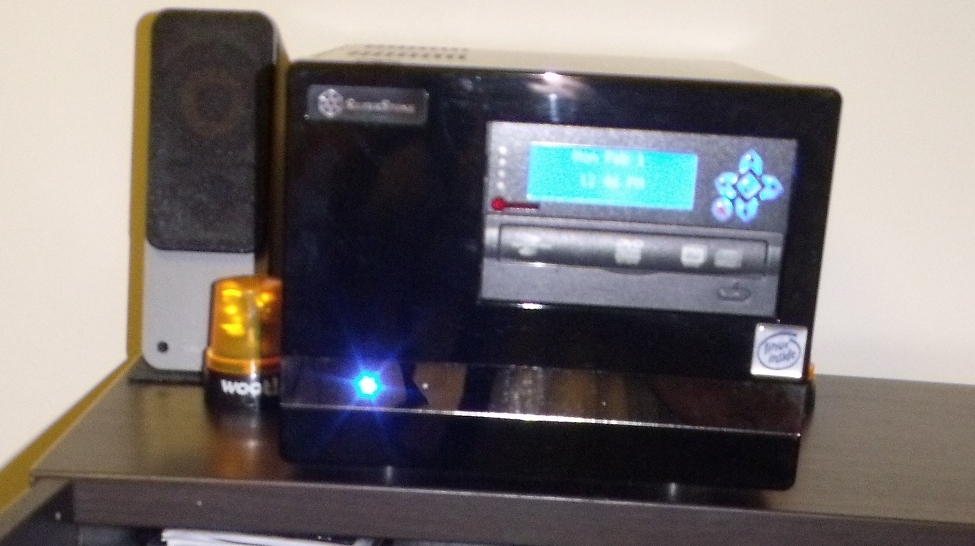
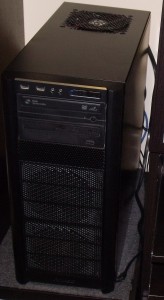
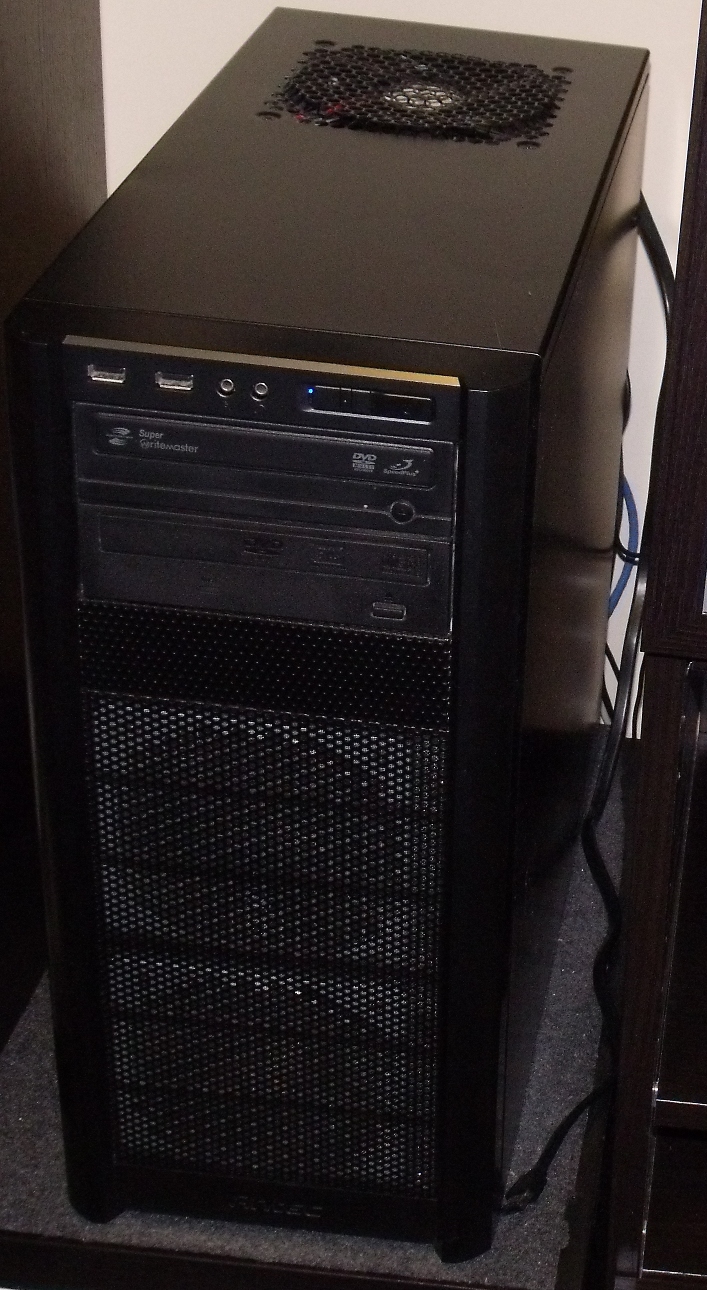
The current iteration, pictured left, is an Antec Three Hundred Mid Tower Case. This model is rather unique in that the power supply is at the bottom of the case, as opposed to the top. It was the first tower we ever had with that configuration. As you can see in the picture, there is space for 2 120mm fans in the front, right in front of the hard drive bays, and there is a washable filter in front of them. The top has a 140mm fan. and the back another 120mm fan. We used the quietest fans we could, but it can be heard as a low hum in the room. There is room for a side exhaust fan, which was have not installed.

There have been several generations of interior boards since the beginning. The current is an Asus board. The thing runs 24 hours a day, so we opted for one which, according to reviews, had high quality capacitors and good build quality. The computer runs headless, so we opted for a board with an onboard graphics card. There was no need for a discrete one when it was never used.

The processor is an AMD Athlon 64 X2 5600+. At the time of purchase, it was the highest speed AMD processor we could get that used 65W of power. Everything else used 95W or above. For our next generation, we are considering going to a higher speed, but low power Intel processor, but we’ll see where the market is when we decide for replacement.

A powerful processor is not inherently necessary for a MythTV backend. If you have a video encoding device that does its own encoding with significant use of the CPU, you could run the thing off of a low-power processor. But if you want to transcode some of your files into a smaller format for long-term storage, it helps to have something that can handle the extra load.

The system has 8GB of RAM, which is overkill, but the RAM was relatively cheap, and easier to install than the processor. Then we get to the hard drives. There are two 500GB drives in a mirroring RAID. So, in the event of failure, the system can go on. Only a small amount of the space is needed for the operating system and the MythTV database. The rest stores important data, our music collection, and any long-term video files.

To store active uncompressed recordings, we are currently taking advantage of MythTV’s storage group function. It distributes the recordings between two Green drives. These drives spin at 5400RPM and are supposed to be more power efficient. One is a WD 1TB and the other a Samsung 1.5TB. Because of the design of MythTV’s storage groups, files can be moved between any of the directories named in the storage group without pausing the server.

This means if one of the drives shows pre-failure, which we recently had, we can move the files to the other drive and take one of them out of commission. We also ensured that the system has an ESATA connector, which would allow us to plug in an external drive and add it to the storage group to keep the system running if we need the extra space.

The computer has two optical drives, and this was originally planned to allow for having one drive used to burn a rewriteable DVD on a time schedule, which would be rotated manually out of the system and placed in backup. That never happened, and at some point in the future, one of them will be replaced by a blu-ray burner, to allow for larger optical backups.

Support for firewire channel changing is what convinced us to dive in fully into MythTV. Originally, the output of the cable box fed into a PVR-150 capture card. Then, firewire recording became more reliable, so the PVR-150 was mostly retired. Finally, when the cable company changed its software and both capture and channel changing became unreliable, we switched to the tried and true infrared channel changing and high-definition capture using the Hauppauge HD-PVR box.

As having only one cable box and HD-PVR would mean we couldn’t resolve any conflicts, we have a Silicondust HDHomerun hooked directly into the cable lines, tuning any unencrypted channels, which are mostly local and public access stations. And, in the event cable goes down entirely, we hooked a line to the old roof antenna, disused for over a decade, and hooked it into an inexpensive card that could tune Over-the-Air digital. Digital Broadcast is often higher quality than the same channel over the cable lines, due to compression, so if you are an HD purest, you probably want to try to supplement your cable with digital broadcast.

The backend, as referenced before, also downloads video programming via MiroBridge and integrates it into the recording menus. This may change as time passes. Speaking of software, our system runs a non-graphical installation of the latest edition of Fedora, currently 12. We periodically update the system after a new release of Fedora has been released long enough for us to feel comfortable upgrading.

We upgrade by making a backup, then moving all the data from the RAID to the recording drives, wiping the RAID drives, installing the new OS, and moving the data back. The whole process takes a few hours, and most of it is waiting for the installation or copy to complete. Most configuration is already setup and just needs to be restored.

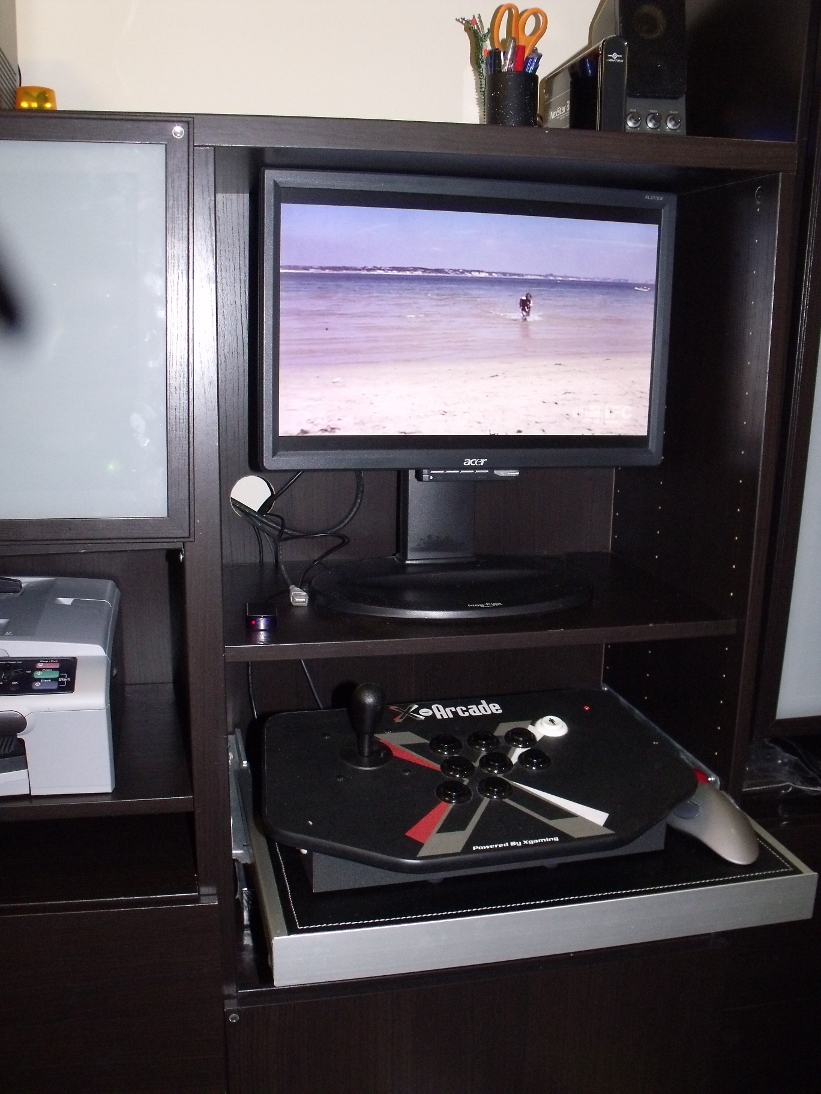
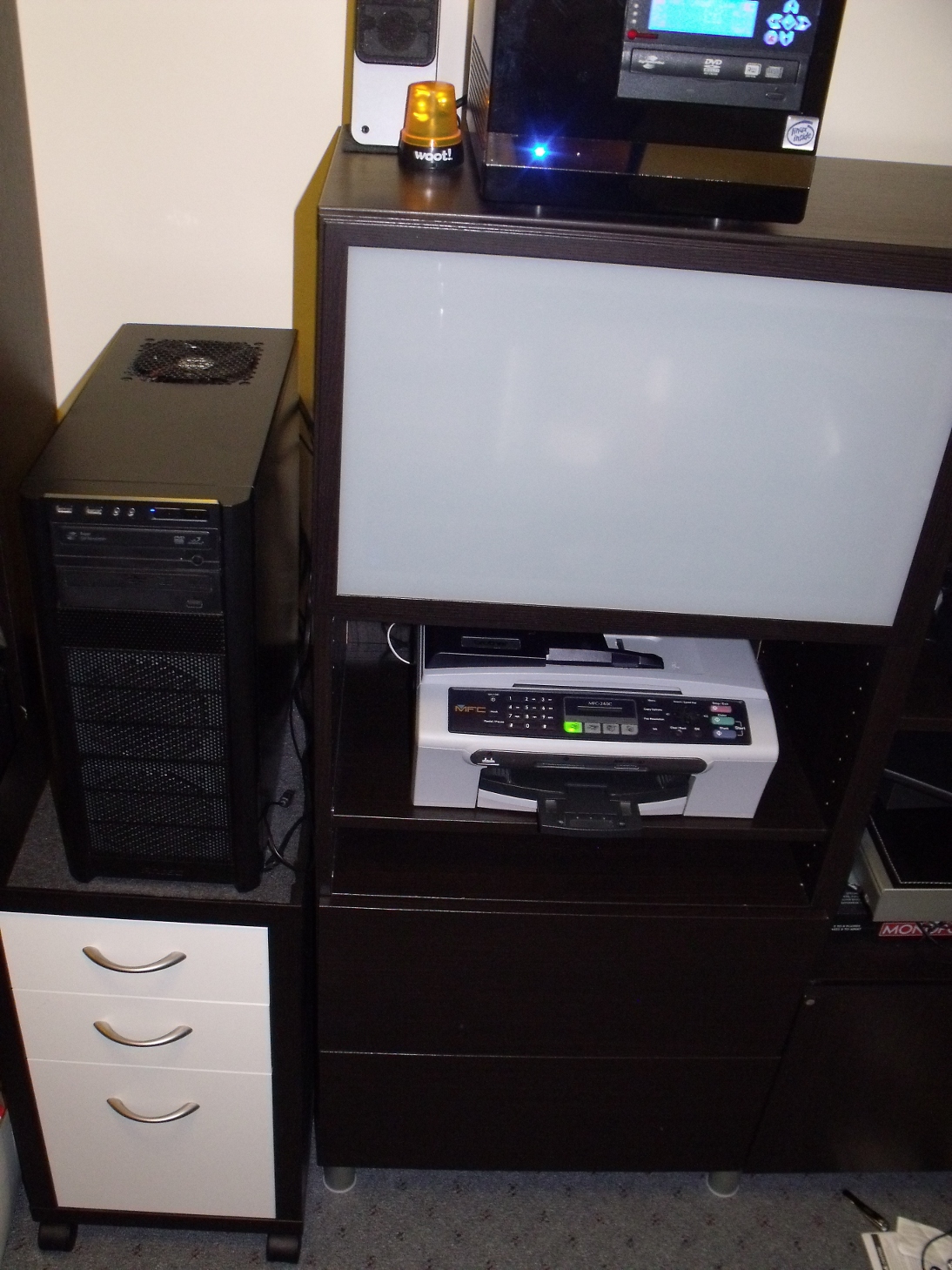
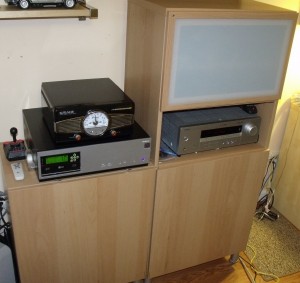
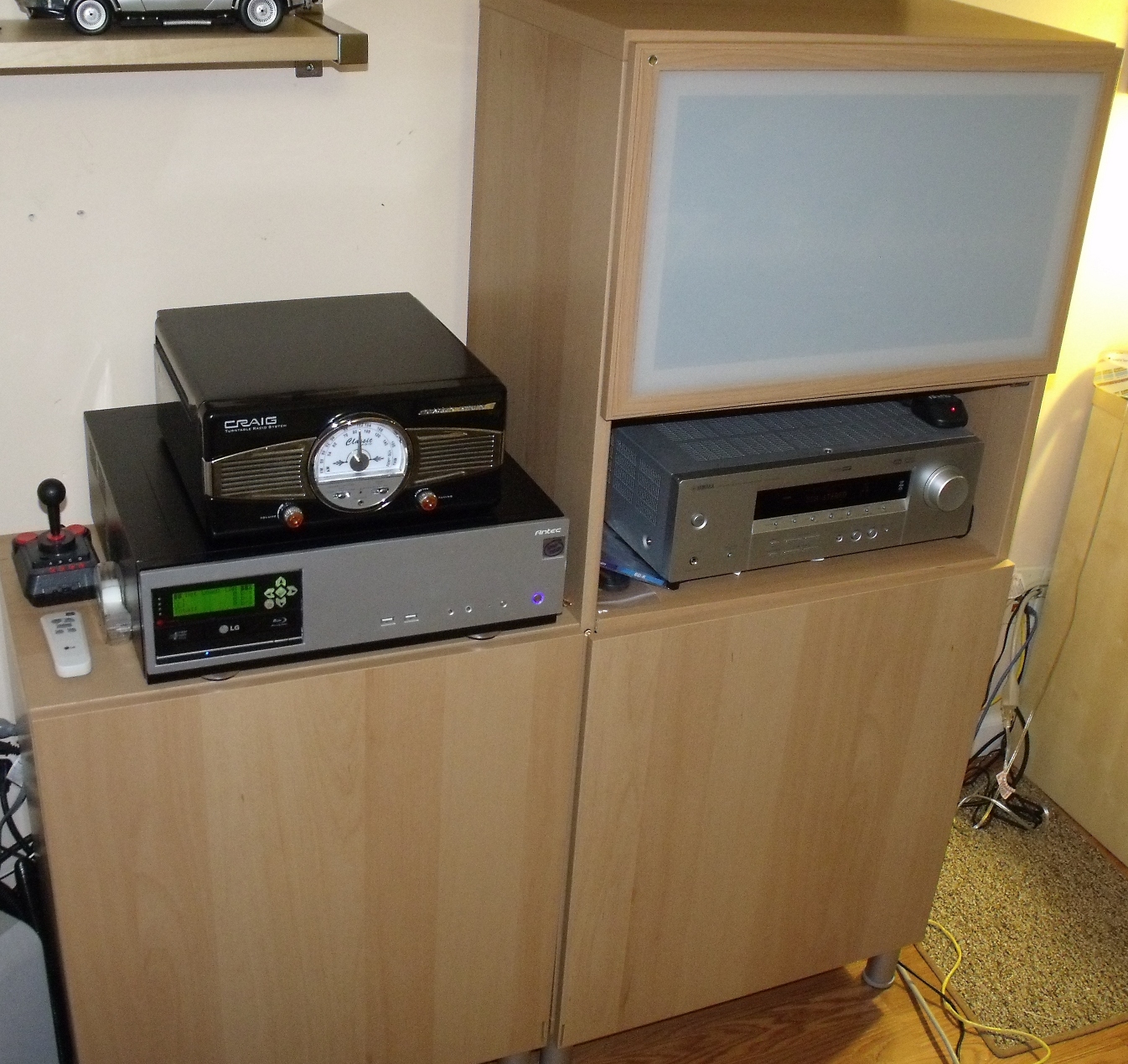
Here’s a wider shot of the system. Last year, we redecorated the room in early Ikea. The backend, codenamed Freshpond, sits on a rolling file cabinet called a Mikael. There is a sound baffling like material under it to prevent scratching, which is a cut piece of Ikea drawer liner. One of these days we may switch to a desk blotter or such for aesthetic reasons. There are both pros and cons to having the system off the ground. Next to it, you can see a printer and one of the two MythTV frontends currently operating. Behind that glass door is the HD-PVR and the cable box.

More on the first frontend, seen in the picture, in Part 2.

Like many, we constantly think about refinements to the system to improve it. Sometimes this is new hardware, sometimes consolidating redundant systems, and sometimes software improvements. For example, in addition to the once hourly check for new internet video from the RSS feeds we monitor to import, a separate job also searches for audio podcasts we have told it to monitor and downloads them.

Ultimately, like any hobby, maintaining the system takes on a passion. But for those of you looking to build a system, it really doesn’t take that much day to day effort and the basic setup is simple. More advance concepts…well, you can always ask someone who has done it. Like us, for example. Comments welcome.

Published on February 16, 2010
Full Post
2 Responses

Bad Luck Comes in Threes – Detecting Hardware Failure

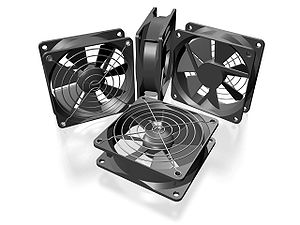
A set of 4 industry standard 80mm fans, most c...
Image via Wikipedia

It would be very easy if we could blame Geektonic for this. After he featured a MythTV system, we agreed to offer him a profile of our primary MythTV setup. It seemed like a good time to dust the system both inside and out, in preparation for some fresh photos.

We have a dedicated MythTV backend which doubles as a file server. We exercise basic power saving functions on it, including CPU frequency scaling. We discovered some hardware problems during the cleaning process.

There was an odd grinding noise that gradually appeared. Originally, we attributed it to a cable hitting against one of the case fans, but there was no such cable. We used velcro cable ties to bundle our cables together just in case. The server scales the CPU to its normal specs only when it is under load. We’d been having crashes whenever we tried any video transcoding. Finally, we tied these two problems we thought unrelated together. The fan was failing, and could handle cooling, but not when the computer went full throttle, during which it gradually overheated till the built-in BIOS shutdown temperature is reached.

So we ran to the store the next day, bought a new CPU fan, and replaced ours. We’re always nervous about pulling off a long-running CPU fan, as the thermal paste used between the heatsink and the processor can tend to act, as the name paste implies, as a bond that could cause damage if you are not very careful in pulling it up. But there were no problems, and the CPU temperatures returned to normal.

Then, today, half a week later, we received notification of prefailure on one of the drives. As we speak, we’re moving data off of it. It will be removed, lashed to a different system, and a manufacturer low-level test mechanism used to check the drive. Either way, it is still under warranty and could be exchanged for replacement by the manufacturer.

It is said bad luck comes in threes, so we thought this was a perfect time to discuss how you can monitor and protect yourself from hardware failure. We’ll focus on these techniques for Linux users, but the idea applies to all systems.

  • S.M.A.R.T.(Self Monitoring, Analysis, and Reporting Tool) -  A system built into every hard drive that monitors several variables to predict drive failure before it happens.
  • Temperature/Fan – There are temperature and fan speed sensors in motherboards that permit monitoring of computers for overheating.

Here are, in our opinion, two very important things you need to enable if you are going to protect your computer. But should be enabled in the motherboard BIOS to start. If your BIOS has a shutdown temperature option, that if reached, will turn the computer off…enable it. Enable SMART reporting as well.

Smartmontools is available in all Linux distributions. Make sure it, or another SMART monitoring tool is enabled and configured to send you an alert if it detects anything. Smartmontools on one of our systems was configured to send an email to the root email account, which was local to the system, and rarely used. Make sure it is sent somewhere you will see it.

For temperature and fans, the standard is LM_Sensors, which may tae some tweaing. Check your estimated CPU temperature in BIOS, then boot and compare it to the one in lm_sensors. If they don’t match, you may need to tweak your settings. Make sure this also generates an alert when it reaches a threshold so you can take action.

We’re a bit mystified as to why features like this aren’t built into Windows, but many manufacturers do offer their own monitoring utilities you can install to monitor vitals. Either way, by setting up your computer early on monitor for these things, you can head off some catastrophic failure. Barring that…backup often.

Published on February 7, 2010
Full Post
1 Response

The iPad…You Can Do Better

SAN FRANCISCO - JANUARY 27:  Apple Inc. CEO St...
Image by Getty Images via Daylife

If you’ve read this blog before, you know we have some very legitimate issues with Apple products, while accepting that they have some useful and popular designs.

The iPad is essentially a giant iPod Touch, with a 10 inch screen, and the ability to run iPhone applications. There are criticisms, many of which are legitimate, but like many things, many wlll accept it because they’ve drank the Apple koolaid and because it has those good features.

Some think it may challenge the Kindle, but while the Kindle certainly has its problems, the iPad uses a conventional LCD screen, which may create readability issues for some over high-contrast E-ink screen of a Kindle or any of its current challengers. As part of the launch, Apple will launch iBook, their own online book store. We look forward to seeing how this plays out.

Can the downsides, and Apple’s unwillingness to respond to public feature requests be overcome by the fact that it is a cool giant iPod Touch with a new E-book service? We’ll wait and see.

Published on January 28, 2010
Full Post
3 Responses

MythTV Rigs

Recently, Geektonic featured a showcase of a MythTV setup. It has inspired us to break out the camera and take some pictures of our own equipment. You’ve already seen some screenshots from our MythTV setup, but coming soon, we’ll be offering some shots and specs on our current equipment setup, as soon as we clean it up.

In the meantime, check out Rothgar’s MythTV setup, courtesy of Geektonic.

Published on January 27, 2010
Full Post
0 Responses

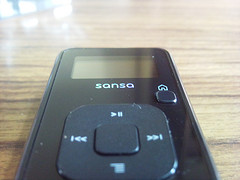
Review: The Sansa Clip Plus

Sansa Clip+ Front
Image by Touzeen Hussain via Flickr

[asa]B002MAPRYU[/asa]

We love the Sansa Clip. We bought a 1GB Clip refurbished a while back, and it replaced a slightly more sophisticated player with video playback capabilities. Sometimes, simplicity is more useful. Now, we’ve replaced our 1GB Sansa Clip with a new Sansa Clip Plus(or Clip+).

The Plus offers a slightly sturdier construction, the buttons have been reorganized, and one big new feature…a microSDHC slot for expansion. It also contains the features that we loved about the Clip.

  • It can play FLAC and OGG files.
  • It has good Podcast and Audiobook support.
  • The sound quality is good.
  • It is REALLY small
  • It has a screen, something the Shuffle lacks
  • It has a built in FM radio

We commented on the Clip+ when it first came out. Sandisk advertises the expansion slot as a slotMusic slot. slotMusic and slotRadio were Sandisk’s attempt at selling preloaded microSD cards, which we still insist, on the face of it, is not a bad idea, but never took off. Sandisk’s implementation was not quite what we thought would work. We’d like to see an on-demand kiosk that would allow you to buy files, load them onto the little card, and that could be available in airports and music stores.

That aside, the Clip form factor is the perfect size for sticking into a bag. Everyone we’ve shown it to, even iPod lovers, have agreed that if you are looking for a simple, utilitarian, good quality music player, the Clip is superior to the iPod shuffle and to many other players on the market in similiar price ranges. For those who are Linux users, or like a simple interface, the Clip offers easy loading of new music by copying it over a USB cable. The jack built-in is a standard Mini-USB jack, as opposed to any proprietary plug.

It relies on ID3 tagging to allow you to browse for files to play, but offers Playlist(created on your computer not the device, although this may change), and an folder browse mode to allow you to select by the directories you have put on the device. When we bought it, there was already a new firmware we could load on, which gives us hope Sandisk will continue to maintain it. AnythinButiPod has a list of possible firmware improvements.

They also show how you can get a microSD to SD converter to, with a corresponding increase in size, get cheaper SD as opposed to microSD memory for the Clip.

Elsewhere, the Clip V1 has unstable support for the Rockbox alternative music firmware and other versions may come someday.

The only complaint we could see having about it is that it is so small, it is easy to lose. We’ve narrowly avoided misplacing it a few times for that reason. But a device being too portable is the sort of complaint we can live with.

Update: There is a newer version of the Sansa Clip, called the Sansa Clip Zip. Have not tried it, but the link appears below.

[asa]B005FVNGRS[/asa]

Published on January 24, 2010
Full Post
1 Response

Musings on Theme Park Technology

http://www.youtube.com/watch?v=KKz6qdexetY

The Carousel of Progress was created by Disney for the 1964 World’s Fair. It features an animatronic show that shows how the American home has changed over four scenes, the turn of the 20th century, the 20s, the 40s, and finally, the most updated piece…the future. Right now the future was determined in 1994.

In a recent trip to Disney World, surprising as it may seem, the Carousel of Progress, despite its lack of popularity, ranked as one of the more interesting rides. Sometimes, simplicity really does just work. But we want more.

In the Twilight Zone Tower of Terror, the ride uses a randomized pattern of movements so the ride is not identical each time. Why can’t all rides be different every time we go through them? Epcot‘s Mission: Space offers a more mild version of the ride for people prone to motion-sickness. Why not ten different versions they can rotate through? Even if it doesn’t change for each passenger, the recordings could change once a day, or once an hour.

Systems like this, ones that adapt and offer a variety of options, are present in computer gaming and a variety of other fields. What do you think? What is the future of theme parks?

Published on January 17, 2010
Full Post
2 Responses

An HDHomeRun with CableCard?

GeekTonic caught this one before us. We’re big fans of the SiliconDust HDHomerun Dual Tuner. SiliconDust has great support, and is well supported under Linux and Windows.

The HDHomerun streams video, once tuned, over the network to your device. Even without the SiliconDust, we think this is part of the future of video. If this device added a decryption device, it would decode the stream and then stream it unencrypted to the computer, allowing access to all channels.

Hopefully, there aren’t any more restrictions beyond that, and they aren’t forced to limit it to Windows only. We could imagine they’d have trouble convincing Cable Labs that Linux users would honor the broadcast flags, but if it does what we hope it does, we’d have one on pre-order the day they came out.

Published on January 3, 2010
Full Post
2 Responses

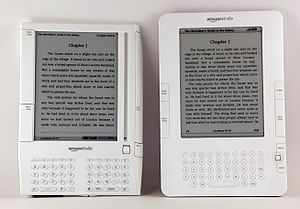
Didn’t Buy an Ebook Reader – But We Were Alone

The front of the Kindle 1 (Left) and Kindle 2 ...
Image via Wikipedia

For a long time, we wavered on the issue of whether to buy an e-book reader. However, after we got a lot of money this holiday season in Amazon gift cards, we wavered and considered reversing ourselves, even though we have major issues with the Kindle.

This holiday season, for the first time, Kindle books outsold traditional books on Amazon, the Kindle itself was the site’s bestselling product.

But even after this, we don’t think the technology is open enough. We didn’t get into music downloading until Amazon released a DRM-free store. It is all about the freedom.

Our latest contemplation, with the delay of purchasing an e-book reader, is to replace our physical classics with free books from the Google Books project, as they are now available in EPUB format, which can be read using the free and open FBReader. What do you think?

Update: Since this post, we have now purchased a Kindle. The price is now manageable. See below link to current Kindle offering.

[asa]B0051QVESA[/asa]

Published on January 3, 2010
Full Post
1 Response

XBMC Releases Version 9.11

XBMC Media Center
Image via Wikipedia

On December 24th, XBMC Version 9.11 was released. It includes a variety of GUI improvements, and playback improvements, including support for RTMP video streams, which is the system that Flash Video players use.

Like Boxee, which is based on it, it doesn’t compile easily under Fedora(our primary operating system), easily, but has wonderful support under Fedora.

The most wonderful aspect of XBMC, which carried into Boxee are the plugins. A loyal community of scripters write plugins to pull in video and audio content from a variety of sites. The difference between XBMC and Boxee is that Boxee often gets cooperation from the content providers for their plugins…in fact, this is part of their goals.

So, give it a shot.

Published on January 3, 2010
Full Post
1 Response

Is the Telephone Dead?

Picture of a Western Electric candlestick phone.
Image via Wikipedia

GigaOm reported this week that AT&T asked the FCC to eliminate regulatory requirements that it support a landline network and to provide a deadline for phasing it out. Essentially, they want to get out of the landline telephone business. Today, less than 20 percent of Americans rely exclusively on switched-access lines for voice service. So, essentially, they want to stop serving 1 in 5 Americans who haven’t switched.

Now, to some degree what they are asking for makes sense if they wanted to provide the same level of service digitally that they do over the old analog network. During the great Northeast blackout a few years back, the phone was one of the few things that still worked. Would that be the case if there was no copper network? Whatever you can say about copper telephone service…it has become very reliable, and AT&T’s profits from it, while reduced over the last few years, remain significant.

However, AT&T wants the federal government to seize power in this area away from the various state and local regulatory authorities and eliminate state requirements that a carrier serve all people in a geographic area. These are the areas where cellular service is spotty and internet service is nearly impossible to come by. Also, while Emergency 911 services on VoIP services have improved, it is still an issue. Every person should have the right to have a reasonably priced method of communication with the outside world available to them, be it telephone, internet, or a combination thereof.

If AT&T is expecting the government to force the elimination of traditional telephone service like they did analog broadcast television, we would hope the government response is for AT&T to come up with something just as reliable and deployable before any discussion can begin. Trying to make the government do their dirty work for them is ridiculous.

We still keep our landline service, despite dabbling in VoIP and owning cellphones. We have a hard time trusting big corporations, but oddly enough, trusting the telephone company to provide traditional telephone service is something we can do more than trusting the cable company. That is not to say the telephone company thrills us with their service either. It is just harder to mess up a traditional telephone.

Published on January 1, 2010
Full Post

Get New Posts By Email