
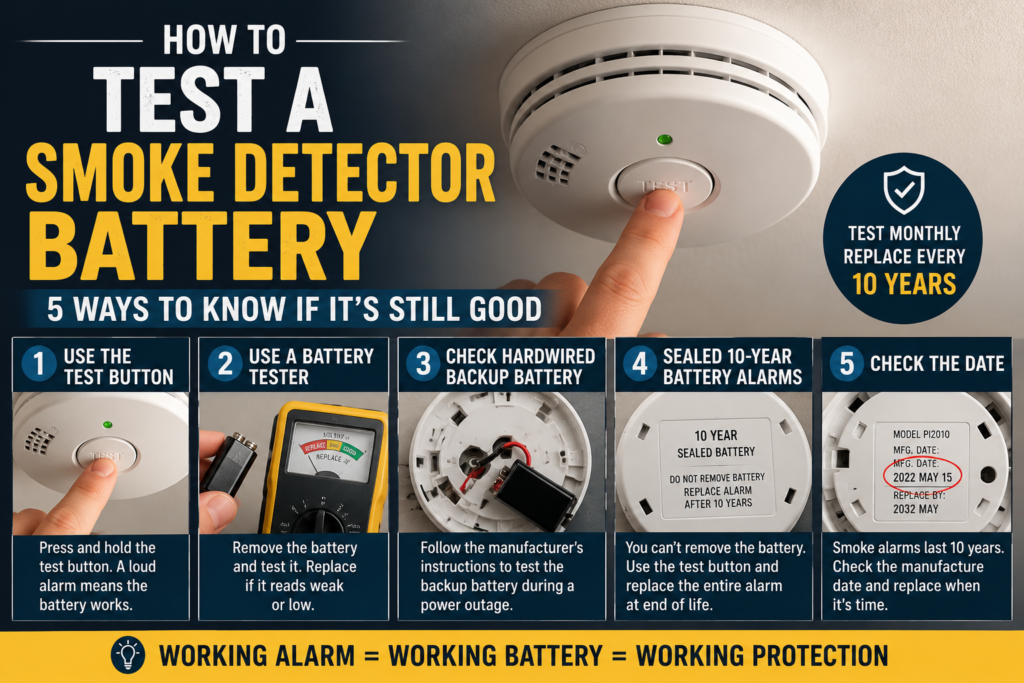
That tests more than the battery. It verifies that the battery has enough power to operate the alarm’s electronics and horn.
But smoke alarms have become more complicated. Some use replaceable 9-volt or AA batteries. Others are hardwired with backup batteries. Many newer alarms contain sealed 10-year batteries that cannot be removed at all.
So how you test the battery depends on what kind of smoke detector you have.
Quick Answer: How Do You Test a Smoke Detector Battery?
- Press and hold the test button. A strong alarm sound is the most important basic test.
- If the battery is removable, inspect and replace it if its age is uncertain.
- Use a battery tester if you want to test a removable battery separately.
- For a hardwired alarm, make sure the backup battery works rather than relying only on AC power.
- For a sealed 10-year alarm, test the alarm itself and check its manufacture date. You cannot replace or separately test the internal battery.
The U.S. Fire Administration recommends testing smoke alarms at least once a month using the test button.
1. Use the Test Button First
The button on the front of the smoke alarm is not merely there to make an annoying noise.
It is the manufacturer’s built-in functional test.
For most alarms:
- Tell anyone nearby that you are about to test the alarm.
- Press and hold the TEST or TEST/HUSH button.
- Wait for the alarm to sound.
- If the alarms are interconnected, confirm that the other alarms also sound.
Kidde says the test button checks the alarm’s electronic circuitry, horn and battery. First Alert similarly recommends regularly testing alarms using the test button.
If the alarm produces a loud, normal test pattern, the battery is providing enough power for the alarm to complete that test.
If it makes a weak sound, no sound, or behaves abnormally, don’t assume everything is fine merely because a status light is illuminated.
A light can tell you the unit has power. It does not replace an actual alarm test.
2. Test a Removable Battery Separately
If your smoke detector uses a replaceable 9-volt, AA or other removable battery, you can also test the battery itself.
A simple household battery tester is the easiest tool.
Remove the battery, connect it to the appropriate contacts on the tester and look at the reading.
A tester that puts the battery under some load is more useful than simply checking its unloaded voltage. A weak battery can sometimes show a seemingly reasonable voltage when nothing is drawing power from it and then sag when the alarm actually needs current.
That is one reason the alarm’s own test button remains the more important test.
If you have any doubt about an inexpensive replaceable battery, I would replace it rather than spend much time trying to prove that it has a little life left.
Can You Test a Smoke Detector Battery With a Multimeter?
Yes, if the battery is removable.
A multimeter can measure the battery’s DC voltage, which can help identify a battery that is obviously depleted.
But I would not use a multimeter reading as proof that the smoke detector is working.
Voltage is only one part of the picture. You still need to reinstall the battery and use the smoke alarm’s test button.
Think of the multimeter as a battery diagnostic tool, not a smoke-alarm test.
3. Test the Backup Battery in a Hardwired Smoke Detector
A hardwired smoke detector usually gets its normal power from your home’s electrical system. Many models also contain a battery so the detector can continue operating during a power outage.
That creates an easy testing mistake.
You press the test button, the alarm sounds, and you conclude that the battery is fine.
But if the alarm is still connected to AC power, you may primarily be proving that the hardwired power supply works.
The exact procedure for testing backup power varies by model, so check the instructions for your alarm.
For some hardwired Kidde alarms with removable backup batteries, the manufacturer instructs users to disconnect the alarm from its wiring harness and press the test button while the alarm is operating on battery power before reinstalling it.
If you are testing a hardwired alarm:
- Identify the exact model first.
- Follow its manufacturer’s testing procedure.
- Do not alter household wiring simply to test the battery.
- After testing, make sure the alarm is fully reconnected and operating normally.
If you have interconnected alarms, test the interconnected system as well. Pressing the test button on one alarm should activate the others when the system is designed to work that way.
4. What If Your Smoke Detector Has a Sealed 10-Year Battery?
This is where a lot of current smoke-detector confusion comes from.
A sealed 10-year smoke alarm does not have a battery you are supposed to remove, put on a tester and reinstall.
The battery is built into the alarm.
You test the entire alarm using its test button.
First Alert describes its sealed 10-year alarms as having batteries that are not designed to be replaced. When the battery or alarm reaches the end of its useful life, you replace the alarm.
If you’re looking all over the detector for a battery door and cannot find one, check the label on the back. It may say something such as:
- 10-year battery
- sealed battery
- non-replaceable battery
- replace alarm after 10 years
This was exactly the issue I ran into when one of my own alarms began chirping. I initially assumed I needed to change a backup battery, only to discover that the battery was permanently built into the alarm.
I wrote about that experience in Why Your Smoke Detector Keeps Chirping After You Change the Battery.
5. Check the Date on the Smoke Detector
A smoke detector can pass its button test and still be old enough that it should be replaced.
Smoke alarms are not lifetime appliances.
The U.S. Fire Administration recommends replacing smoke alarms every 10 years. NFPA guidance similarly calls for replacing smoke alarms at 10 years unless the manufacturer specifies otherwise.
Take the alarm down and look for the manufacturing date printed on the back.
Do not assume that the date you bought the house or remember installing the detector is the date that matters.
If the detector is approaching or beyond its rated service life, replace it even if pressing the test button still makes noise.
This is also why, when I install an alarm, I like to write the installation date where I can find it later.
Does a Green Light Mean the Smoke Detector Battery Is Good?
Not necessarily.
LED meanings vary by manufacturer and model.
On many hardwired alarms, a steady green light indicates that the unit is receiving AC power. That tells you something useful—but it does not necessarily tell you that the backup battery is healthy or that the entire alarm is functioning properly.
Kidde specifically notes that a power-status light is not a substitute for using the test button.
Consult the label or manual for your alarm before interpreting its LEDs.
What If the Test Button Does Nothing?
If you press the test button and the alarm does not sound, treat that as a problem that needs to be fixed now.
For a detector with a replaceable battery:
- Make sure the battery is installed in the correct direction.
- Make sure the battery contacts are making proper contact.
- Install a fresh battery of the type specified by the manufacturer.
- Test the alarm again.
If it still does not sound, replace the alarm.
For a sealed-battery detector, there generally is no battery replacement step. If the alarm fails its test after following the manufacturer’s troubleshooting instructions, replace the unit.
For a hardwired alarm, confirm that it has AC power and follow the manufacturer’s troubleshooting procedure. If the alarm itself has failed, replace it.
What If the Alarm Sounds Weak During the Test?
I would treat an unusually weak, distorted or intermittent test sound as a warning rather than declaring the alarm good.
Kidde advises that an erratic or low alarm sound can indicate a fault.
If the unit uses a replaceable battery, install a fresh battery and test it again.
If the sound remains abnormal—or if the alarm is near the end of its service life—replace the detector.
Should You Test a Smoke Detector With Real Smoke?
Do not use a match, candle, lighter or other open flame to test a smoke alarm.
Kidde specifically warns against igniting combustible material to test an alarm because you could damage the detector or start a fire.
For routine homeowner testing, use the alarm’s test button as directed by the manufacturer.
There are specialized aerosol products used for certain detector tests, but you should only use a testing method specifically permitted by the manufacturer of your particular alarm. Spraying random substances into a smoke detector is not a substitute for following its instructions.
How Often Should You Test a Smoke Detector Battery?
The better question is how often you should test the alarm.
The U.S. Fire Administration, CPSC and other fire-safety organizations recommend testing smoke alarms at least once a month.
I would also test an alarm after:
- Replacing its battery
- Installing a new alarm
- A power outage if it is hardwired
- Removing and reinstalling the unit
- Renovation or heavy dust near the detector
- Any situation where you have reason to wonder whether it is operating correctly
First Alert specifically recommends testing after battery changes and power outages in addition to regular monthly testing.
Do You Still Need to Replace Smoke Detector Batteries Every Year?
It depends entirely on the alarm.
| Alarm Type | Battery Maintenance |
|---|---|
| Replaceable-battery smoke alarm | Replace the battery according to the manufacturer’s instructions; traditional guidance is at least annually. |
| Hardwired alarm with replaceable backup battery | Maintain and replace the backup battery according to the manufacturer’s instructions. |
| Sealed 10-year battery alarm | Do not replace the internal battery. Replace the entire alarm when it reaches end of life or fails. |
| Hardwired alarm with sealed backup battery | The backup battery is not intended for routine replacement; replace the alarm at end of life. |
The old advice to change every smoke-detector battery when you change the clocks made sense when almost every alarm used a conventional replaceable battery.
That is no longer true.
Many current alarms use sealed batteries designed to last for the service life of the detector.
Battery Problem or Dead Smoke Detector?
These symptoms can help narrow it down:
| Symptom | What to Check |
|---|---|
| Alarm does not sound during test | Battery installation, power source, alarm age; replace if it still fails |
| Alarm chirps periodically | Low battery, improperly installed battery or end-of-life warning |
| New battery but still chirping | Alarm age, sealed battery/end-of-life warning, reset procedure |
| Green light but no test alarm | Do not rely on the light; troubleshoot or replace the alarm |
| Alarm is 10 years old | Replace the alarm even if it still passes a basic test |
| Several alarms begin chirping around the same time | Check manufacture dates; they may all be reaching end of life together |
If your problem is specifically a detector that keeps chirping after you’ve already changed the battery, see our smoke-detector chirping troubleshooting guide.
When Should You Replace the Whole Smoke Detector?
Replace the detector if:
- It fails the manufacturer’s test procedure
- A fresh battery does not restore normal operation
- It has reached the manufacturer’s stated end of life
- It is around 10 years old and due for replacement
- A sealed battery has reached end of life
- The unit is physically damaged or malfunctioning
If you need a replacement, I’ve also put together a guide to the best smoke and carbon monoxide detectors in 2026, including hardwired, battery-powered and smart options.
Frequently Asked Questions
How do I know if my smoke detector battery is low?
A periodic chirp often indicates a low battery, but chirp patterns vary by model and can also indicate that the entire alarm has reached end of life. Check the manufacturer’s instructions and the manufacture date rather than assuming every chirp means the battery needs replacement.
How do I test a 9-volt smoke detector battery?
You can use a battery tester or multimeter to check a removable 9-volt battery, but the more important test is to reinstall it in the alarm and press the smoke detector’s test button. That verifies that the battery can actually operate the alarm.
Can I test a smoke detector battery without removing it?
Yes. Pressing the alarm’s test button is the normal way to verify that the alarm and its power source are functioning. For a sealed-battery alarm, this is the appropriate method because the battery is not intended to be removed.
How do I test a 10-year smoke detector battery?
You generally do not test the sealed battery separately. Press the alarm’s test button according to the manufacturer’s instructions and check the detector’s age. If a sealed-battery alarm reaches end of life or fails its test, replace the entire unit.
Does pressing the test button really test the smoke detector?
It tests important parts of the alarm, including its power supply, electronics and horn. Manufacturers specifically recommend the test-button procedure for routine testing. It does not mean the detector should remain in service beyond its rated lifespan.
Why does my smoke detector still chirp with a new battery?
The battery may not be the problem. The detector may need to be reset, the battery may not be seated correctly, or the alarm may have reached the end of its service life. Many newer alarms contain sealed batteries and must be replaced when they reach end of life.
How often should I press the smoke detector test button?
At least once a month. The U.S. Fire Administration and CPSC both recommend monthly testing.
The Test Button Tells You More Than a Battery Meter
If all you want to know is whether your smoke detector’s battery is doing its job, start with the test button.
A battery tester or multimeter can be useful for diagnosing a removable battery, but a good voltage reading does not tell you that the smoke alarm itself works.
Press the test button monthly. Check the date on the detector. And if an alarm fails its test or has reached the end of its service life, replace it rather than trying to squeeze a little more life out of one of the most important safety devices in your house.
