Gadget Wisdom

Tag: home safety

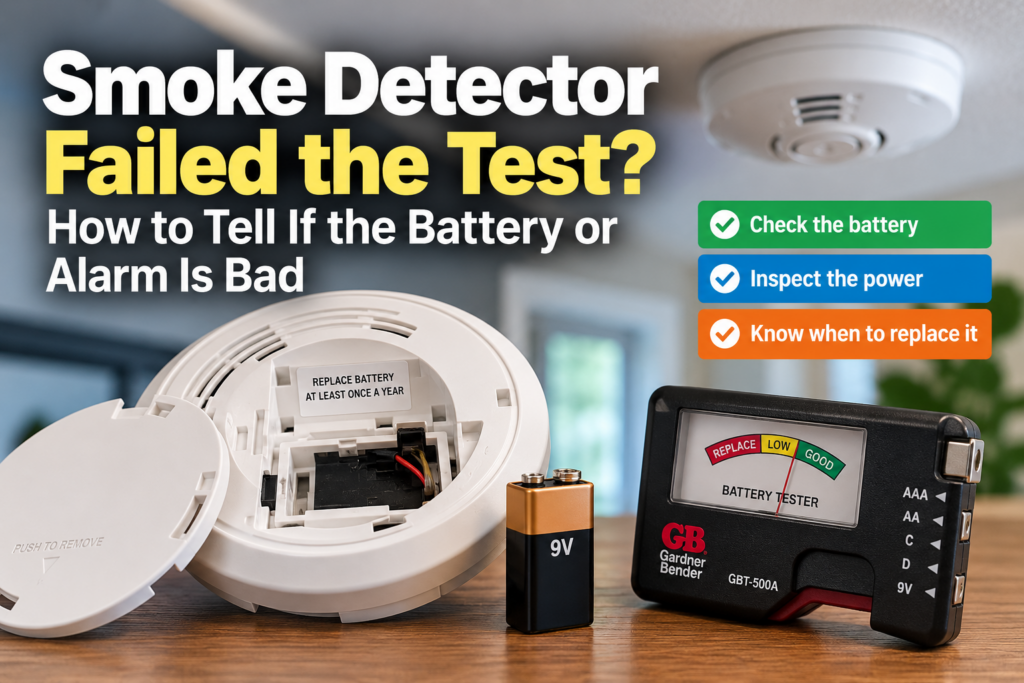
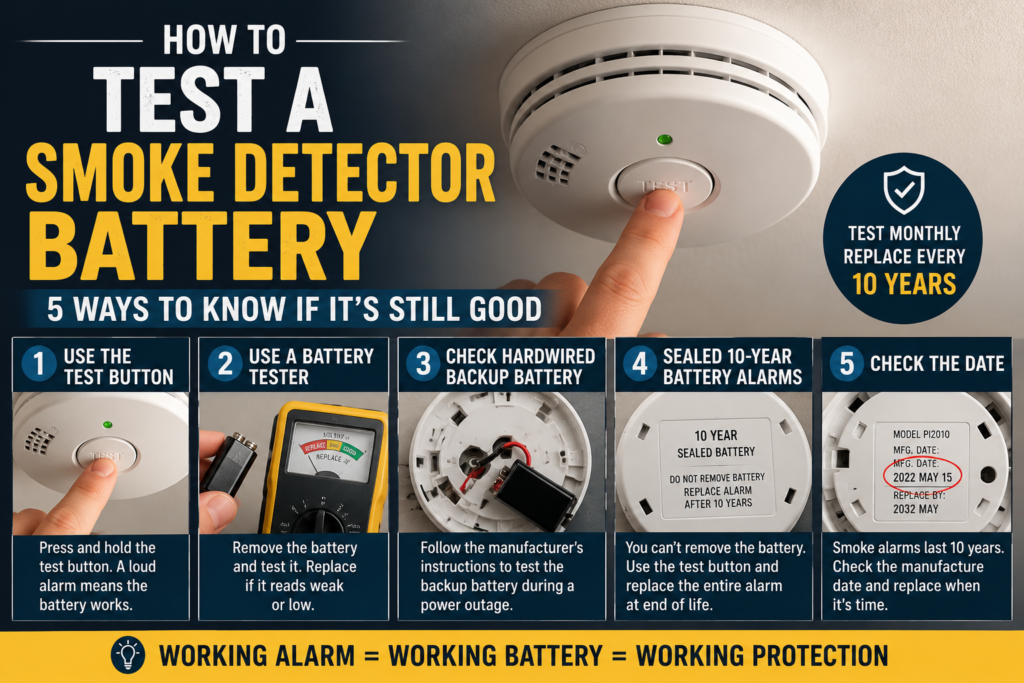
Smoke detector battery testing guide showing the test button, battery tester, hardwired backup battery, sealed 10-year alarm, and manufacture date.
0 Responses

How to Test a Smoke Detector Battery: 5 Ways to Know If It’s Still Good

If you want to know whether a smoke detector battery is still good, the most useful test is surprisingly simple: press the alarm’s test button.

That tests more than the battery. It verifies that the battery has enough power to operate the alarm’s electronics and horn.

But smoke alarms have become more complicated. Some use replaceable 9-volt or AA batteries. Others are hardwired with backup batteries. Many newer alarms contain sealed 10-year batteries that cannot be removed at all.

So how you test the battery depends on what kind of smoke detector you have.

Quick Answer: How Do You Test a Smoke Detector Battery?

  1. Press and hold the test button. A strong alarm sound is the most important basic test.
  2. If the battery is removable, inspect and replace it if its age is uncertain.
  3. Use a battery tester if you want to test a removable battery separately.
  4. For a hardwired alarm, make sure the backup battery works rather than relying only on AC power.
  5. For a sealed 10-year alarm, test the alarm itself and check its manufacture date. You cannot replace or separately test the internal battery.

The U.S. Fire Administration recommends testing smoke alarms at least once a month using the test button.

1. Use the Test Button First

The button on the front of the smoke alarm is not merely there to make an annoying noise.

It is the manufacturer’s built-in functional test.

For most alarms:

  1. Tell anyone nearby that you are about to test the alarm.
  2. Press and hold the TEST or TEST/HUSH button.
  3. Wait for the alarm to sound.
  4. If the alarms are interconnected, confirm that the other alarms also sound.

Kidde says the test button checks the alarm’s electronic circuitry, horn and battery. First Alert similarly recommends regularly testing alarms using the test button.

If the alarm produces a loud, normal test pattern, the battery is providing enough power for the alarm to complete that test.

If it makes a weak sound, no sound, or behaves abnormally, don’t assume everything is fine merely because a status light is illuminated.

A light can tell you the unit has power. It does not replace an actual alarm test.

2. Test a Removable Battery Separately

If your smoke detector uses a replaceable 9-volt, AA or other removable battery, you can also test the battery itself.

A simple household battery tester is the easiest tool.

Remove the battery, connect it to the appropriate contacts on the tester and look at the reading.

A tester that puts the battery under some load is more useful than simply checking its unloaded voltage. A weak battery can sometimes show a seemingly reasonable voltage when nothing is drawing power from it and then sag when the alarm actually needs current.

That is one reason the alarm’s own test button remains the more important test.

If you have any doubt about an inexpensive replaceable battery, I would replace it rather than spend much time trying to prove that it has a little life left.

Can You Test a Smoke Detector Battery With a Multimeter?

Yes, if the battery is removable.

A multimeter can measure the battery’s DC voltage, which can help identify a battery that is obviously depleted.

But I would not use a multimeter reading as proof that the smoke detector is working.

Voltage is only one part of the picture. You still need to reinstall the battery and use the smoke alarm’s test button.

Think of the multimeter as a battery diagnostic tool, not a smoke-alarm test.

3. Test the Backup Battery in a Hardwired Smoke Detector

A hardwired smoke detector usually gets its normal power from your home’s electrical system. Many models also contain a battery so the detector can continue operating during a power outage.

That creates an easy testing mistake.

You press the test button, the alarm sounds, and you conclude that the battery is fine.

But if the alarm is still connected to AC power, you may primarily be proving that the hardwired power supply works.

The exact procedure for testing backup power varies by model, so check the instructions for your alarm.

For some hardwired Kidde alarms with removable backup batteries, the manufacturer instructs users to disconnect the alarm from its wiring harness and press the test button while the alarm is operating on battery power before reinstalling it.

If you are testing a hardwired alarm:

  • Identify the exact model first.
  • Follow its manufacturer’s testing procedure.
  • Do not alter household wiring simply to test the battery.
  • After testing, make sure the alarm is fully reconnected and operating normally.

If you have interconnected alarms, test the interconnected system as well. Pressing the test button on one alarm should activate the others when the system is designed to work that way.

4. What If Your Smoke Detector Has a Sealed 10-Year Battery?

This is where a lot of current smoke-detector confusion comes from.

A sealed 10-year smoke alarm does not have a battery you are supposed to remove, put on a tester and reinstall.

The battery is built into the alarm.

You test the entire alarm using its test button.

First Alert describes its sealed 10-year alarms as having batteries that are not designed to be replaced. When the battery or alarm reaches the end of its useful life, you replace the alarm.

If you’re looking all over the detector for a battery door and cannot find one, check the label on the back. It may say something such as:

  • 10-year battery
  • sealed battery
  • non-replaceable battery
  • replace alarm after 10 years

This was exactly the issue I ran into when one of my own alarms began chirping. I initially assumed I needed to change a backup battery, only to discover that the battery was permanently built into the alarm.

I wrote about that experience in Why Your Smoke Detector Keeps Chirping After You Change the Battery.

5. Check the Date on the Smoke Detector

A smoke detector can pass its button test and still be old enough that it should be replaced.

Smoke alarms are not lifetime appliances.

The U.S. Fire Administration recommends replacing smoke alarms every 10 years. NFPA guidance similarly calls for replacing smoke alarms at 10 years unless the manufacturer specifies otherwise.

Take the alarm down and look for the manufacturing date printed on the back.

Do not assume that the date you bought the house or remember installing the detector is the date that matters.

If the detector is approaching or beyond its rated service life, replace it even if pressing the test button still makes noise.

This is also why, when I install an alarm, I like to write the installation date where I can find it later.

Does a Green Light Mean the Smoke Detector Battery Is Good?

Not necessarily.

LED meanings vary by manufacturer and model.

On many hardwired alarms, a steady green light indicates that the unit is receiving AC power. That tells you something useful—but it does not necessarily tell you that the backup battery is healthy or that the entire alarm is functioning properly.

Kidde specifically notes that a power-status light is not a substitute for using the test button.

Consult the label or manual for your alarm before interpreting its LEDs.

What If the Test Button Does Nothing?

If you press the test button and the alarm does not sound, treat that as a problem that needs to be fixed now.

For a detector with a replaceable battery:

  1. Make sure the battery is installed in the correct direction.
  2. Make sure the battery contacts are making proper contact.
  3. Install a fresh battery of the type specified by the manufacturer.
  4. Test the alarm again.

If it still does not sound, replace the alarm.

For a sealed-battery detector, there generally is no battery replacement step. If the alarm fails its test after following the manufacturer’s troubleshooting instructions, replace the unit.

For a hardwired alarm, confirm that it has AC power and follow the manufacturer’s troubleshooting procedure. If the alarm itself has failed, replace it.

What If the Alarm Sounds Weak During the Test?

I would treat an unusually weak, distorted or intermittent test sound as a warning rather than declaring the alarm good.

Kidde advises that an erratic or low alarm sound can indicate a fault.

If the unit uses a replaceable battery, install a fresh battery and test it again.

If the sound remains abnormal—or if the alarm is near the end of its service life—replace the detector.

Should You Test a Smoke Detector With Real Smoke?

Do not use a match, candle, lighter or other open flame to test a smoke alarm.

Kidde specifically warns against igniting combustible material to test an alarm because you could damage the detector or start a fire.

For routine homeowner testing, use the alarm’s test button as directed by the manufacturer.

There are specialized aerosol products used for certain detector tests, but you should only use a testing method specifically permitted by the manufacturer of your particular alarm. Spraying random substances into a smoke detector is not a substitute for following its instructions.

How Often Should You Test a Smoke Detector Battery?

The better question is how often you should test the alarm.

The U.S. Fire Administration, CPSC and other fire-safety organizations recommend testing smoke alarms at least once a month.

I would also test an alarm after:

  • Replacing its battery
  • Installing a new alarm
  • A power outage if it is hardwired
  • Removing and reinstalling the unit
  • Renovation or heavy dust near the detector
  • Any situation where you have reason to wonder whether it is operating correctly

First Alert specifically recommends testing after battery changes and power outages in addition to regular monthly testing.

Do You Still Need to Replace Smoke Detector Batteries Every Year?

It depends entirely on the alarm.

Alarm Type Battery Maintenance
Replaceable-battery smoke alarm Replace the battery according to the manufacturer’s instructions; traditional guidance is at least annually.
Hardwired alarm with replaceable backup battery Maintain and replace the backup battery according to the manufacturer’s instructions.
Sealed 10-year battery alarm Do not replace the internal battery. Replace the entire alarm when it reaches end of life or fails.
Hardwired alarm with sealed backup battery The backup battery is not intended for routine replacement; replace the alarm at end of life.

The old advice to change every smoke-detector battery when you change the clocks made sense when almost every alarm used a conventional replaceable battery.

That is no longer true.

Many current alarms use sealed batteries designed to last for the service life of the detector.

Battery Problem or Dead Smoke Detector?

These symptoms can help narrow it down:

Symptom What to Check
Alarm does not sound during test Battery installation, power source, alarm age; replace if it still fails
Alarm chirps periodically Low battery, improperly installed battery or end-of-life warning
New battery but still chirping Alarm age, sealed battery/end-of-life warning, reset procedure
Green light but no test alarm Do not rely on the light; troubleshoot or replace the alarm
Alarm is 10 years old Replace the alarm even if it still passes a basic test
Several alarms begin chirping around the same time Check manufacture dates; they may all be reaching end of life together

If your problem is specifically a detector that keeps chirping after you’ve already changed the battery, see our smoke-detector chirping troubleshooting guide.

When Should You Replace the Whole Smoke Detector?

Replace the detector if:

  • It fails the manufacturer’s test procedure
  • A fresh battery does not restore normal operation
  • It has reached the manufacturer’s stated end of life
  • It is around 10 years old and due for replacement
  • A sealed battery has reached end of life
  • The unit is physically damaged or malfunctioning

If you need a replacement, I’ve also put together a guide to the best smoke and carbon monoxide detectors in 2026, including hardwired, battery-powered and smart options.

Frequently Asked Questions

How do I know if my smoke detector battery is low?

A periodic chirp often indicates a low battery, but chirp patterns vary by model and can also indicate that the entire alarm has reached end of life. Check the manufacturer’s instructions and the manufacture date rather than assuming every chirp means the battery needs replacement.

How do I test a 9-volt smoke detector battery?

You can use a battery tester or multimeter to check a removable 9-volt battery, but the more important test is to reinstall it in the alarm and press the smoke detector’s test button. That verifies that the battery can actually operate the alarm.

Can I test a smoke detector battery without removing it?

Yes. Pressing the alarm’s test button is the normal way to verify that the alarm and its power source are functioning. For a sealed-battery alarm, this is the appropriate method because the battery is not intended to be removed.

How do I test a 10-year smoke detector battery?

You generally do not test the sealed battery separately. Press the alarm’s test button according to the manufacturer’s instructions and check the detector’s age. If a sealed-battery alarm reaches end of life or fails its test, replace the entire unit.

Does pressing the test button really test the smoke detector?

It tests important parts of the alarm, including its power supply, electronics and horn. Manufacturers specifically recommend the test-button procedure for routine testing. It does not mean the detector should remain in service beyond its rated lifespan.

Why does my smoke detector still chirp with a new battery?

The battery may not be the problem. The detector may need to be reset, the battery may not be seated correctly, or the alarm may have reached the end of its service life. Many newer alarms contain sealed batteries and must be replaced when they reach end of life.

How often should I press the smoke detector test button?

At least once a month. The U.S. Fire Administration and CPSC both recommend monthly testing.

The Test Button Tells You More Than a Battery Meter

If all you want to know is whether your smoke detector’s battery is doing its job, start with the test button.

A battery tester or multimeter can be useful for diagnosing a removable battery, but a good voltage reading does not tell you that the smoke alarm itself works.

Press the test button monthly. Check the date on the detector. And if an alarm fails its test or has reached the end of its service life, replace it rather than trying to squeeze a little more life out of one of the most important safety devices in your house.

Published on August 27, 2026
Full Post
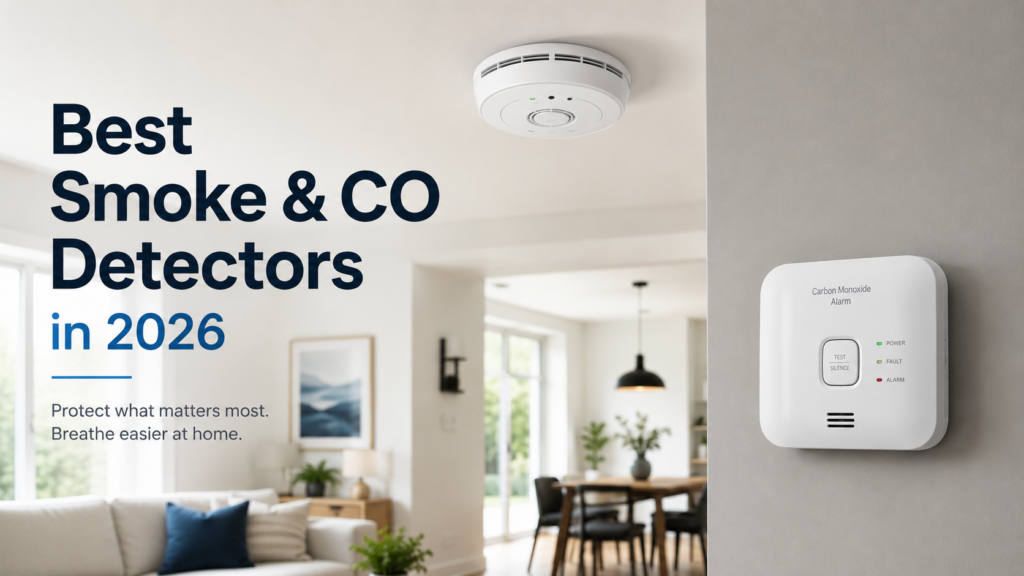
Smoke and carbon monoxide detectors on a ceiling and wall, illustrating the best smoke and CO alarms in 2026
0 Responses

Best Smoke and Carbon Monoxide Detectors in 2026: 6 Picks

Updated August 2026

Disclosure: As an Amazon Associate I earn from qualifying purchases. Product links may earn a commission at no additional cost to you.

Smoke detectors are one of those products most people ignore until one starts chirping in the middle of the night. Then you discover that the alarm on your ceiling may be ten years old, the battery may not be replaceable, and the replacement choices are much more complicated than they look.

I recently went through exactly that problem when one of my hardwired alarms reached the end of its life. That sent me back into the current smoke-alarm market, which has changed considerably.

You can now choose between hardwired alarms with 10-year backup batteries, battery-only combination units, voice alerts, wired interconnection, phone notifications, Ring integration and smart alarms designed to replace Google Nest Protect.

Quick answer: If I needed a conventional hardwired smoke and carbon monoxide alarm today, I would start with the Kidde 30CUA10-V. If I did not have hardwired power, I would choose the Kidde 30CUD10-V. For remote notifications, I would choose between the Kidde Ring Smart Smoke + CO Alarm and the First Alert SC5, depending on which smart-home ecosystem I wanted to use.

Model Power Detection Best For Buy
Kidde 30CUA10-V Hardwired + 10-year backup Smoke + CO Best overall hardwired choice Check price
First Alert SMICO105-AC Hardwired + 10-year backup Smoke + CO First Alert/BRK wired systems Check price
Kidde 20SA10-V Hardwired + 10-year backup Smoke only Homes with separate CO detection Check price
Kidde 30CUD10-V Sealed 10-year battery Smoke + CO Best choice without hardwired power Check price
Kidde RGCUAR-RW Hardwired + AA backup Smoke + CO Ring users and remote alerts Check price
First Alert SC5 / SMCO600NV Battery powered Smoke + CO Google Home and Nest Protect replacement Check price

First, Figure Out What You Are Replacing

Before ordering anything, take one of your existing alarms down and read the label on the back.

Write down:

  • The manufacturer
  • The model number
  • The manufacture date
  • Whether it is hardwired or battery-only
  • Whether there is an interconnect wire
  • Whether it detects smoke only or smoke and carbon monoxide

If you have a hardwired interconnected system, this is particularly important. You should not assume that an alarm from another manufacturer—or even every alarm from the same manufacturer—can simply be mixed into the existing interconnect network.

Check the replacement alarm’s compatibility documentation before buying a houseful of them.

Best Overall Hardwired Smoke and CO Alarm: Kidde 30CUA10-V

The Kidde 30CUA10-V is the conventional alarm I would start with for a new hardwired installation.

It combines smoke and carbon monoxide detection in one unit, runs from house power, includes a 10-year backup battery and provides voice alerts. It can also use the hardwired interconnect so compatible Kidde alarms throughout the house sound together.

The 10-year backup battery is especially appealing. A hardwired alarm still needs backup power when utility power is out, but there is no 9-volt battery to remember to change every year.

Voice alerts are another feature I like. Instead of receiving only a generic siren, the alarm can announce whether the warning is for fire or carbon monoxide.

I would buy it for: a hardwired home where I want combination smoke and CO protection, wired interconnection, voice alerts and no routine backup-battery changes.

Check the Kidde 30CUA10-V on Amazon

Best First Alert Hardwired Replacement: SMICO105-AC

If your house already uses compatible First Alert or BRK hardwired alarms, the First Alert SMICO105-AC may be the more natural replacement.

It is a hardwired combination smoke and CO alarm with a 10-year battery backup and wired interconnect support. First Alert also uses a quick-connect plug intended to simplify replacement in compatible installations.

This is an important point when replacing alarms: the “best” alarm on paper is not always the best replacement for the wiring already in your ceiling.

If I already had a house full of compatible First Alert or BRK alarms, I would strongly prefer staying within the approved interconnect family rather than changing brands one detector at a time.

I would buy it for: an existing compatible First Alert or BRK hardwired system where I want a modern combination alarm and 10-year backup battery.

Check the First Alert SMICO105-AC on Amazon

Best Hardwired Smoke-Only Alarm: Kidde 20SA10-V

You do not necessarily need every detector in the house to contain a carbon monoxide sensor.

If your home already has appropriate separate CO detection, the Kidde 20SA10-V gives you the same basic hardwired approach in a smoke-only alarm.

It includes a 10-year backup battery, voice alerts and hardwired interconnection with compatible Kidde alarms.

This can make sense in a larger house where combination smoke/CO alarms are installed in the locations that need CO protection while additional smoke-only alarms provide the required fire coverage elsewhere.

Follow your local fire and building requirements when deciding where smoke and CO alarms are required.

I would buy it for: additional hardwired smoke protection in a compatible Kidde system where carbon monoxide detection is already provided separately.

Check the Kidde 20SA10-V on Amazon

Best 10-Year Battery Smoke and CO Alarm: Kidde 30CUD10-V

Many houses do not have electrical wiring at every smoke-alarm location. The building I live in was built in the 1970s and originally had no hardwired power for the detectors, so I understand the problem.

If you are not opening ceilings and running new electrical wiring, the Kidde 30CUD10-V is the simplest choice in this group.

It combines smoke and CO detection with a sealed 10-year battery and voice alerts. There is no annual battery replacement and no electrical connection to install.

The tradeoff is that this model does not give you the wired interconnection of the hardwired Kidde models above.

If your alarm reaches the end of its service life, you replace the entire alarm. That may sound wasteful until you remember that smoke alarms themselves are not lifetime devices.

I learned that lesson when one of my own sealed-battery alarms started chirping and could not be fixed with a battery change. I wrote about the experience in Why Your Smoke Detector Keeps Chirping After You Change the Battery.

I would buy it for: a location without hardwired alarm power where I want a simple combination smoke/CO alarm without routine battery replacement.

Check the Kidde 30CUD10-V on Amazon

Best Smart Smoke Detector for Ring: Kidde RGCUAR-RW

The Kidde RGCUAR-RW solves a problem I complained about in the earlier version of this article: getting modern hardwired smoke and CO detection with useful wireless connectivity.

This model is hardwired, uses two AA batteries for backup and integrates directly with the Ring app. It can send notifications for smoke, carbon monoxide and low battery conditions when you are away from home. Kidde says another Ring device is not required.

That makes it particularly interesting for a vacation home, rental property or any house that sits empty for stretches of time.

A local alarm is designed to warn people inside the building. A remote notification gives you a chance to learn about a problem when nobody is there to hear it.

I would not buy a smart smoke detector solely because it is smart. The core job is still detecting smoke and CO and sounding an alarm. But if I already use Ring and want remote fire-safety notifications, this is a much more compelling product than trying to bolt a separate smart-home relay onto the interconnect wire.

I would buy it for: a hardwired home where Ring is already part of the monitoring system, especially a second home or property that is sometimes unoccupied.

Check the Kidde Ring Smart Smoke + CO Alarm on Amazon

For the rest of the second-home monitoring problem, see my guide to vacation-home remote monitoring.

Best Nest Protect Replacement: First Alert SC5

Google Nest Protect created a loyal following because it combined smoke and CO detection, voice warnings, interconnected alarms and phone notifications in a polished product.

The current First Alert SC5 is particularly interesting because First Alert designed it to work with and replace Nest Protect.

The battery model linked here is model SMCO600NV. It combines photoelectric smoke detection and electrochemical CO detection with voice and location alerts, Wi-Fi connectivity, mobile notifications and wireless interconnection with compatible alarms.

First Alert says it can work alongside Nest Protect through Google Home, which makes it the obvious model to investigate if an aging Nest Protect needs replacement.

Unlike the sealed 10-year Kidde battery model above, the SC5 battery model uses replaceable lithium batteries. Its appeal is the connected feature set rather than never having to replace a battery.

I would buy it for: someone replacing Nest Protect or building a smart smoke/CO system around Google Home and First Alert.

Check the First Alert SC5 on Amazon

Hardwired or Battery?

If the house already has hardwired smoke-alarm power, I would normally continue using it. Hardwired alarms receive normal power from the house and use their battery as backup.

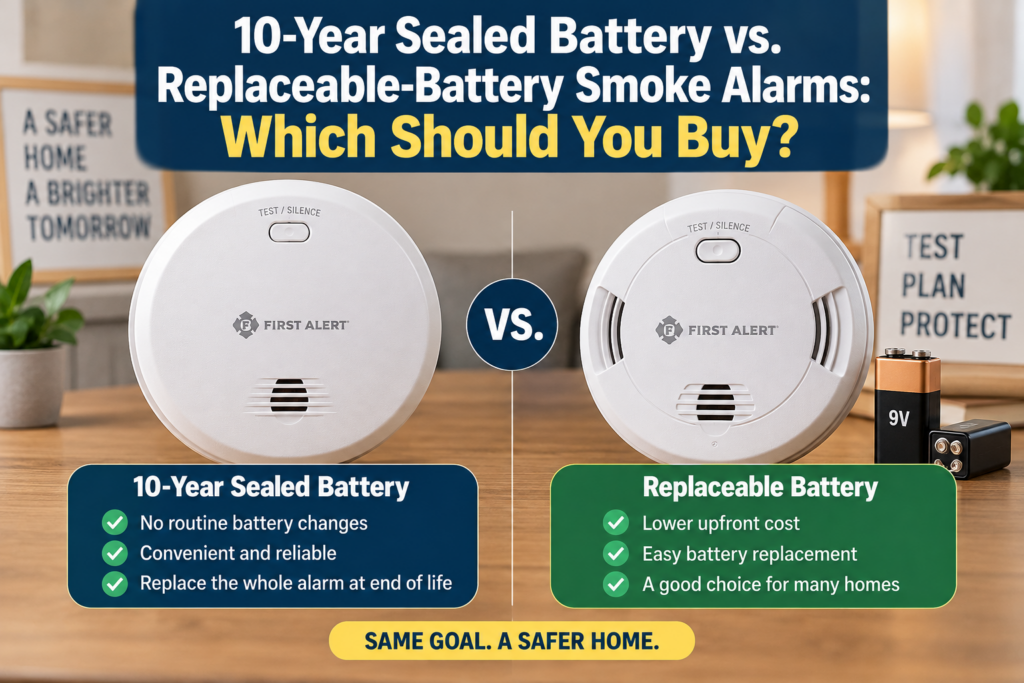
If wiring is not already available, a 10-year sealed-battery alarm avoids the electrical work and eliminates routine battery changes.

Situation What I Would Choose
Existing hardwired alarm network Compatible hardwired replacement
No wiring at the alarm location 10-year battery model
Existing First Alert/BRK interconnected system Compatible First Alert/BRK model
Existing Kidde interconnected system Compatible Kidde model
Want Ring notifications Kidde Ring Smart alarm
Replacing Nest Protect First Alert SC5

Why Interconnected Smoke Alarms Matter

Interconnection means that when one alarm detects a problem, compatible alarms elsewhere in the house sound too.

That is particularly useful in a larger or multi-story home. A fire beginning in a basement, garage area or distant bedroom should not depend on someone upstairs hearing one alarm through several closed doors.

Interconnection can be wired or wireless, depending on the product.

The important word is compatible. Do not assume that every alarm with an interconnect feature can communicate with every other alarm.

What Changed With Newer Smoke Alarms?

Smoke-alarm standards continue to evolve. Current UL requirements include tests intended to improve detection of modern fires while reducing nuisance alarms caused by cooking.

That is useful because nuisance alarms create their own safety problem: people sometimes disable an alarm that goes off too often and then forget to restore it.

If I am replacing a ten-year-old alarm today, I would buy a current model from a major manufacturer rather than searching for an identical decade-old model simply because the old mounting plate looks familiar.

You can read more about the newer smoke-alarm requirements from UL Solutions.

How Many Smoke Alarms Do You Need?

The National Fire Protection Association recommends smoke alarms inside every sleeping room, outside each separate sleeping area and on every level of the home, including the basement.

Carbon-monoxide requirements depend on the home and local code, so check your state and local rules as well as the manufacturer’s instructions.

More expensive combination alarms can simplify a system, but buying one combination smoke/CO alarm does not automatically mean you have enough alarms for the entire house.

See the NFPA smoke-alarm guidance when planning locations.

How Often Should You Test a Smoke Detector?

Use the alarm’s test button at least once a month. NFPA and CPSC both recommend regular monthly testing.

A status light is not a substitute for pressing the test button. The point of the test is to verify that the alarm responds.

This is also why I would not assume a detector is healthy merely because it has not started chirping.

If you are trying to diagnose an existing detector, read what to do when a smoke detector keeps chirping after a battery change.

When Should You Replace a Smoke Alarm?

NFPA recommends replacing smoke alarms when they are 10 years old, measured from the manufacture date. An alarm that fails its test should be replaced sooner.

Combination smoke and CO alarms can have model-specific service lives, so check the label and manufacturer’s instructions.

When one old detector reaches end of life, check the dates on the rest of the alarms in the house. If they were all installed together, the others may be approaching replacement at the same time.

My Buying Decision

If I were installing a conventional hardwired system today, the Kidde 30CUA10-V would be my first choice from this group.

If the house already had a compatible First Alert/BRK interconnect network, I would choose the SMICO105-AC instead of changing ecosystems without a reason.

Without hardwired power, I like the simplicity of the Kidde 30CUD10-V.

For a property where remote notifications are important, I would choose the smart ecosystem first: Kidde with Ring or First Alert SC5 with Google Home.

Whichever model you choose, check the date on the existing alarms before ordering. A chirping detector may be telling you that one battery needs attention. It may also be telling you that the entire generation of alarms in your house is ready for replacement.

Frequently Asked Questions

What is the best smoke and carbon monoxide detector?

For a conventional hardwired home, I like the Kidde 30CUA10-V because it combines smoke and CO detection, a 10-year backup battery, voice alerts and hardwired interconnection. The best replacement can change if your house already has a compatible First Alert, BRK or Kidde interconnected system.

Should I buy separate smoke and CO detectors or a combination alarm?

Combination alarms simplify installation and reduce the number of devices on the ceiling or wall. Separate alarms can make sense where you need additional smoke detection but already have adequate carbon-monoxide coverage. Follow local requirements for both types of detection.

Are 10-year smoke detector batteries really good for 10 years?

Sealed long-life alarms are designed so the battery does not require routine replacement during the alarm’s service life. The alarm should still be tested regularly, and a unit that fails testing or reaches its specified end of life should be replaced.

Can I replace a hardwired smoke detector with any brand?

Do not assume so. Hardwired alarms may use different electrical connectors and interconnect requirements. Check the replacement model’s compatibility information before mixing alarms or changing brands.

What is the best smart smoke detector after Nest Protect?

The First Alert SC5 is specifically designed to work with and replace Google Nest Protect and supports Google Home. The Kidde Ring Smart Smoke + CO Alarm is a strong alternative for households built around Ring.

Do smart smoke alarms still work if the internet goes down?

The alarm itself is designed to provide local smoke and CO warnings independently of a phone notification. Internet connectivity is used for remote smart features, so do not treat an app alert as a replacement for properly installed local alarms.

How often should I test smoke alarms?

Test smoke alarms at least once a month using the test button. Replace an alarm that does not respond properly.

How old is too old for a smoke detector?

NFPA recommends replacing smoke alarms when they reach 10 years from the manufacture date. Check combination smoke/CO alarms for the model-specific replacement interval printed on the device or in its instructions.

Published on September 15, 2025
Full Post

Get New Posts By Email