
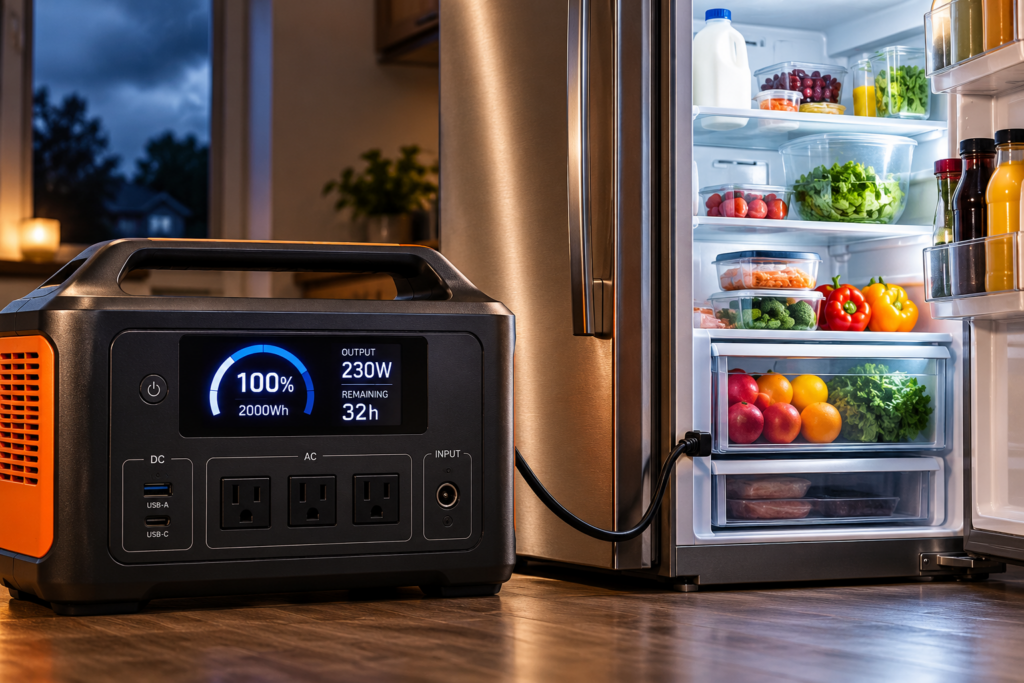
You do need enough battery capacity to last through the outage and an inverter capable of starting the refrigerator’s compressor. Those are two different specifications, and confusing them is one of the easiest ways to buy the wrong power station.
For many households, a 2kWh portable power station is the practical sweet spot. A 1kWh unit can make sense for shorter outages or an efficient refrigerator, while 4kWh becomes much more attractive if you want to run a refrigerator and separate freezer, expect outages to last well into a second day, or plan to power other household essentials at the same time.
The Quick Answer
| Battery Size | Best Fit | My Take |
|---|---|---|
| ~1kWh | Short outages, efficient refrigerator, minimum cost and weight | Useful, but limited margin |
| ~2kWh | Refrigerator through an overnight outage, plus small essential loads | Best starting point for most homes |
| ~4kWh | Longer outages, refrigerator + freezer, or more household loads | Much better endurance, but heavier and more expensive |
| More than 4kWh | Multi-day backup or several substantial household loads | Start comparing batteries with generators and home-backup systems |
The right answer depends much more on your refrigerator’s energy consumption than on the wattage printed on its nameplate.
Start With kWh per Day, Not Refrigerator Wattage
A refrigerator might draw well over 100 watts while its compressor is operating, but the compressor does not normally run continuously. It cycles on and off as needed to maintain temperature.
That means seeing “180 watts” on a label and multiplying 180 × 24 will usually give you a terrible runtime estimate.
A better starting point is the refrigerator’s annual electricity consumption. The yellow EnergyGuide label required on refrigerators provides estimated annual energy use in kilowatt-hours. The FTC explains how EnergyGuide labels work here.
Divide the annual number by 365 to get a rough daily figure.
For example, suppose your refrigerator’s EnergyGuide label says:
400 kWh per year
Divide by 365:
400 ÷ 365 = about 1.10 kWh per day.
That is far more useful for battery sizing than the refrigerator’s instantaneous wattage.
Do Not Assume You Can Use Every Watt-Hour in the Battery
A power station advertised as 2,000Wh contains approximately 2kWh of nominal battery capacity. You should not assume all 2,000Wh will reach the refrigerator.
There are conversion losses in the inverter, power consumed by the power station itself and other real-world inefficiencies. Conditions also vary with temperature, load and the particular hardware.
For rough outage planning, I like using 80% of nominal capacity rather than pretending the specification on the box is completely usable AC energy.
| Advertised Capacity | Conservative Planning Capacity at 80% |
|---|---|
| 1,000Wh | 800Wh |
| 2,000Wh | 1,600Wh |
| 4,000Wh | 3,200Wh |
That is deliberately a planning estimate rather than a claim that every power station operates at exactly 80% efficiency.
How Long Will 1kWh, 2kWh and 4kWh Run a Refrigerator?
Using that 80% planning factor gives us a useful comparison.
| Refrigerator Energy Use | 1kWh Station | 2kWh Station | 4kWh Station |
|---|---|---|---|
| 0.8 kWh/day | ~24 hours | ~48 hours | ~96 hours |
| 1.2 kWh/day | ~16 hours | ~32 hours | ~64 hours |
| 1.6 kWh/day | ~12 hours | ~24 hours | ~48 hours |
These are estimates for the refrigerator alone. They assume no solar charging and no router, television, lights, laptop, freezer or coffee maker sharing the battery.
Your actual refrigerator can also consume more during hot weather, after the doors have been opened repeatedly or when it is trying to recover after warming up.
A Real Example With a 400 kWh/Year Refrigerator
Go back to our refrigerator rated at 400 kWh per year, or approximately 1.10 kWh per day.
A 1kWh station with an 800Wh planning budget gives:
0.8 ÷ 1.10 = 0.73 days, or about 17 hours.
A 2kWh station gives approximately 1.6kWh of planning capacity:
1.6 ÷ 1.10 = 1.45 days, or about 35 hours.
A 4kWh system gives approximately 3.2kWh:
3.2 ÷ 1.10 = 2.9 days, or about 70 hours.
That is why I think 2kWh is such a useful size for refrigerator backup. It gives you substantially more breathing room than a 1kWh battery without immediately moving into a much larger and heavier backup system.
Better Yet: Measure Your Refrigerator
The EnergyGuide label is a useful estimate, but your kitchen is not a government laboratory.
Refrigerator energy use changes with room temperature, door openings, thermostat settings, age, ice makers, defrost cycles and other factors. If you are buying an expensive battery specifically to keep one refrigerator alive, measuring the actual appliance is worth doing.
A plug-in electricity meter can tell you how many kilowatt-hours the refrigerator consumes over 24 or 48 hours. Measure for longer if possible so the test captures normal compressor and defrost cycles.
Once you have that number, the calculation becomes simple:
Estimated runtime in days = usable battery kWh ÷ refrigerator kWh per day.
That number will be more useful than almost any refrigerator-runtime claim printed in a power-station advertisement.
Battery Capacity Is Only Half the Problem: The Compressor Has to Start
A refrigerator uses relatively modest energy over an entire day, but the compressor can briefly demand substantially more power when it starts.
This is where the inverter specification matters.
A power station could theoretically contain enough energy to run your refrigerator for 20 hours and still fail if its AC inverter cannot handle the compressor’s startup demand. Check both the continuous AC output and the manufacturer’s surge or peak specification.
The current 2kWh units we compared recently provide between 2,200W and 3,000W of continuous AC output, which gives them substantial headroom for ordinary refrigerator duty. Our comparison of the current Jackery, Anker, EcoFlow and BLUETTI 2kWh power stations goes through those differences in detail.
Smaller power stations deserve more scrutiny. Do not assume a battery is suitable for a refrigerator merely because its capacity is listed as 1,000Wh.
1kWh: Enough for Shorter Outages
A roughly 1kWh portable power station can be a sensible refrigerator backup if your priorities are lower cost, lighter weight and getting through relatively short outages.
For an efficient refrigerator, it may cover much of a day. For a more power-hungry appliance, the useful window can be considerably shorter.
The limitation is margin. Once you begin charging phones, running networking equipment or adding lights, the battery that looked adequate for the refrigerator alone begins disappearing more quickly.
I would choose this size if I had measured the refrigerator, knew its consumption was low and primarily wanted protection against outages lasting several hours rather than multiple days.
2kWh: The Size I Would Start With
For general home-outage use, 2kWh is where portable power stations become much more comfortable.
You have enough stored energy to give a typical refrigerator meaningful overnight endurance while still having room for modest additional loads. Phones, LED lights, a modem, router and laptops consume relatively little compared with high-draw heating or cooking appliances.
It is also a mature product category. Current 2kWh stations combine roughly 2,000Wh of storage with AC inverters powerful enough for refrigerators and many other ordinary 120V household appliances.
If this calculation points you toward that size, see our Best 2kWh Portable Power Stations in 2026. That article compares the current Jackery Explorer 2000 v2, Anker SOLIX C2000 Gen 2, EcoFlow DELTA 3 Max Plus and BLUETTI Elite 200 V2 and includes current purchase links.
4kWh: Better for a Refrigerator Plus Freezer
A separate freezer changes the calculation because you now have two compressor-driven appliances drawing from the same battery.
Do not simply assume the freezer consumes the same amount as the refrigerator. Check its EnergyGuide figure or measure it separately, then add the two daily kWh numbers together.
If the refrigerator uses 1.1kWh per day and the freezer uses another 0.8kWh, your total is 1.9kWh per day before accounting for power-station losses.
A 2kWh battery becomes roughly a one-day solution in that scenario. A 4kWh system gives you much more useful endurance.
This is also where expandability becomes valuable. If your present needs fit within 2kWh but you think a second appliance or longer outage may eventually push you toward 4kWh, buying an expandable system can make more sense than replacing the original station later.
Do You Need to Run the Refrigerator Continuously?
The goal is to keep food at a safe temperature, not necessarily to have the compressor powered every second of an outage.
USDA says an unopened refrigerator will generally keep food safely cold for about four hours during a power outage. A full standalone freezer can maintain temperature for approximately 48 hours, or about 24 hours when half full, if the door stays closed. USDA’s current outage guidance is here.
That does not mean I would intentionally let a refrigerator warm up for four hours every time the power fails. It does mean the thermal mass inside the appliance gives you some flexibility.
Keep the doors closed, use an appliance thermometer and avoid wasting stored battery energy on loads that do not matter while the outage is still developing.
What About Your Router, Lights and Other Essentials?
A refrigerator rarely lives alone on an outage plan.
You may also want internet access, phone charging, some lighting and perhaps a television or computer. Those smaller loads may each look insignificant, but they reduce refrigerator runtime when they run for hours.
Suppose the refrigerator requires 1.1kWh per day and your networking gear averages another 40W. Forty watts running continuously adds almost another 1kWh per day.
That is enough to change the battery-size decision.
I still prefer a conventional UPS for keeping network equipment and a NAS running through brief outages and power interruptions. Our guide to choosing a UPS for a router and modem covers that role. A larger power station can then take over when an outage lasts long enough that UPS runtime becomes the limiting factor.
Do Not Waste a Battery on Electric Heat
One of the easiest ways to destroy your refrigerator-runtime calculation is to plug a high-wattage heating appliance into the same battery.
A 1,500W space heater, electric kettle or similar load can consume energy at a completely different rate from a refrigerator. A 2kWh battery that might support a refrigerator for a day can be drained by sustained high-power heating in roughly an hour or two.
The fact that a large inverter can operate an appliance does not mean using that appliance during an outage is sensible.
Reserve battery capacity for loads where electricity accomplishes a lot with relatively little energy: refrigeration, communications, electronics and efficient lighting.
Solar Changes the Question on Day Two
Battery capacity tells you how long you can operate without putting energy back into the system. Once an outage lasts several days, recharge capability becomes just as important.
A 2kWh battery that can harvest meaningful solar energy each day can be more useful during a long outage than a larger battery with no practical way to recharge it.
This is one of the important differences among current power stations. In our 2kWh comparison, maximum solar input ranges from 400W on the Jackery Explorer 2000 v2 to 800W on the Anker and 1,000W on the EcoFlow and BLUETTI.
Real solar production is lower than panel nameplate ratings much of the time because clouds, sun angle, shade and temperature all matter. Still, higher charging capability becomes increasingly valuable once you are trying to replenish yesterday’s refrigerator consumption rather than merely survive tonight.
When a Generator Starts Making More Sense
If your planning scenario requires 6kWh, 10kWh or more simply to survive a long outage, I would stop automatically assuming that another stack of batteries is the answer.
A portable power station is excellent for quiet indoor operation, overnight use and outages lasting hours rather than days. A generator can replenish its energy supply as long as you can safely operate it outdoors and continue obtaining fuel.
For some homes, the best system is both: use battery power quietly overnight and run a generator periodically to handle larger loads and recharge the battery.
Our portable power station vs. generator comparison goes deeper into where each approach makes sense.
My Sizing Recommendation
If I were buying a portable power station primarily for refrigerator backup, I would first find the refrigerator’s annual kWh figure or measure its actual daily consumption.
For a typical one-refrigerator outage plan, I would generally start around 2kWh. It gives useful endurance without immediately committing to the weight and cost of a much larger system, and today’s 2kWh models generally provide ample inverter output for ordinary refrigerators.
I would consider 1kWh if I had a particularly efficient refrigerator, wanted protection mainly from shorter outages or cared strongly about portability. I would move toward 4kWh if I were backing up both a refrigerator and freezer, wanted substantially more than a day of battery-only runtime or expected to add meaningful additional loads.
Beyond that, I would think less about buying the biggest battery available and more about how the system will be recharged during a multi-day outage.
The best portable power station for your refrigerator is therefore not the one with the largest number on the box. It is the smallest system that can handle the compressor, supply your measured daily energy requirement with useful margin and still fit the outage plan you actually expect to use.
