Gadget Wisdom

Author: David Shanske

Registration time

2011-09-25 06:23:49

Website

https://david.shanske.com/

Email

david@shanske.com

All posts by David Shanske

0 Responses

MyMediaPlayer2 for Hulu Released

Techcrunch reported that developer Paul Yanez, who developed Adobe Air application My Media Player, which we posted about in November, has released a second version of his application. It features 400 TV shows and 208 movies from Hulu, and there is a full-screen mode that apparently works with a remote, as well as Twitter integration. The unfortunate problem is the application becomes disabled every time Hulu makes a major change to its service. Yanez suggests we email them to complain.

Yanez has released his framework and thoughts on building a media player. He wants it integrate with all web video, be easy to use, have a television style feel and be fully integrated with mobile devices.

If you don’t want to try Adobe Air, you can try the application out in a Browser window, by clicking here. Of course, it wasn’t working for us. Maybe we should complain to Hulu. It kept saying Video Unavailable.

We think Hulu should be developing an app like this themselves…or encouraging/hiring Yanez to do so for them. We’ve long complained about a lack of TV-like functionality on Hulu and other sites. And now, under pressure from content providers, these sites are limiting third party development of such software.

Reblog this post [with Zemanta]
Published on March 3, 2009
Full Post
4 Responses

More on Fedora

Linux distribution
Image via Wikipedia

After our post yesterday on Fedora, we received a comment from Paul W. Frields, who is the Fedora Project Leader and chairman of the Fedora Project Board. He wrote:

I think the idea that we’re “regaining” users implies that we lost them somewhere along the way, which isn’t what our statistics show. Rather, as the total size of the Linux-user pie has become larger, we’ve continued to grow consistently. There will always be distro-hoppers looking for that elusive perfect Linux distribution — and more often than not, failing in that quest — but in general the strength of our development model, rapid release cycle, and putting the freshest software in front of users in a stable, easy to manage platform have retained users’ hearts for a long time. It’s true that we may not have the marketing push of Ubuntu; it’s a fine distribution and community, but given the choice between marketing features and creating them, we definitely choose the latter. We’re very happy that many of the features we create are adopted by other distributions, because that shows, first, the strength of the free software development model; and second, that our policy of working directly with the upstream, as opposed to creating a crazy quilt of technically questionable patches in our own distribution alone, is the winning strategy for long-term sustainability.

And he is right, we were inaccurate with the title. Fedora is improving its share of the overall Linux market, which continues to grow. There has been a lot of growth on the Ubuntu front, because of their aggressive marketing push. We’ve noticed developers seem to be releasing Ubuntu packaging and not is offering up-to-date Fedora packing.

Three pieces of software we’ve referenced on this blog come to mind. Dropbox, Boxee, and XBMC. Dropbox is a file sync application which offers a current Ubuntu package, but only a Fedora 9 rpm(which fortunately works with Fedora 10). XBMC and Boxee are both supported under Ubuntu, and maintained there, but require a series of source code hacks to work under Fedora.

Now, this is hardly a reflection on Fedora. XBMC and Boxee contain multimedia packages that Fedora cannot include for legal reasons…nor can Ubuntu for that matter. It is a reflection on our original point…essentially that Fedora(which we use) is gaining popularity. As Paul reminded us, one of the best parts of Fedora is that they work directly with upstream maintainers…those who write the packages Fedora is assembled from, such as the Gnome Desktop, which is a major part of multiple distributions, so that the alterations are done at a level above the individual distribution. Thus Fedora enhances the overall Linux experiences for all users, by being involved.

Reading a draft of this article on Fedora, it states that “the Fedora project has four basic foundations, the 4 Fs, its corner stones. Freedom, Friends, Features and First are the core values that govern us.”

“Freedom” represents the dedication to free software. It lays emphasis on the creation, usage and promotion of free, open source alternatives to proprietary or closed source solutions. Our aim is to provide software that is reliable as well as a hundred percent legally redistributable to everyone.

“Friends” signifies the strength of the community. The project consists of people from different parts of the world with different ideas and views with belief in Fedora’ s core values as their binding force. Everyone who wants to help is welcome at the community. Our decisions and steps are taken after a consensus is reached, as between friends!

“Features” represents our commitment to excellence. Fedora is responsible for the creation and constant improvement of software that takes the Linux world forward. It is for the benefit of all users of free software regardless of their distribution of choice.

Lastly, “first” represents our commitment to innovation. It signifies that every major step in the project is taken with a view of the future. Fedora is described as a bleeding edge distribution that always provides the latest available for Linux.

Fedora has some great features/goals for Fedora 11. They include, to name a few:

  • 20 Second Startup – Part of their continual goal to speed this up
  • Automatic Font and Mime Installer – Allowing programs on the desktop to automatically install fonts, codecs, and clipart
  • CrashCatcher – to help users with bug reporting
  • Ext4 – Replace the default ext3 partitioning scheme with ext4, its successor.
  • Updating the following included programs: Firefox to version 3.1, gcc to 4.4, Gnome to 2.26, NetBeans to 6.5, Python to 2.6, Thunderbird to 3, Xfce to 4.6, Xserver to 1.6.
  • Improved Fingerprint Reader support
  • Multiseat support – making it easy to  a single computer to operate with independent keyboard, mouse, and monitor for multiple users
  • Improve Power Management
  • Presto – Presto supports upgrades using DeltaRPMS. A DeltaRPM is a file that only has the differences between the last version of the software and the new one, allowing it to be much smaller. The DeltaRPM can be used to generate the updated package. This will reduce overall load on servers by not requiring users to download pieces of a file they already have.
  • Volume Control improvements – There have been problems with volume control since Fedora added Pulseaudio
  • Windows Cross-Compiler – Allows users to compile Windows programs without Windows

And many more…We look forward to enjoying them.

Reblog this post [with Zemanta]
Published on March 2, 2009
Full Post
0 Responses

NBC Direct offering HD Downloads of Shows

Image representing NBC Universal as depicted i...
Image via CrunchBase

For Windows only, NBC is offering an application that runs in the background and can download and watch shows offline. It works with Firefox or Internet Explorer, and contains both ads and restricted use, ensuring you can’t copy the files or transfer them to your mobile device.

Now, DRM annoys us, but ultimately, we understand it on any service offered free. We hate it on services we pay for. The software also has some downsides. By installing it, you agree to be added to the NBC P2P(Peer-to-Peer) network. So other NBC Direct users will be downloading files from your computer as you download from theirs…essentially the same system BitTorrent uses.

We object to this, as from what we’ve read, it gives NBC too much control over your connection speed. We like the idea of being able to download a file and play it, eliminating the buffer issues that plague so many of these sites. But in an ideal universe, we’d prefer digital rights management implemented in the following manner.

You download a video file. If it is to be done by P2P, a P2P client can be used. Or direct download can be offered. The DRM is in the player. The file is impossible to decode without a locked player that requires an internet connection to work to get a decryption key. And the key can be cached along with the ads to work for a certain number of hours without an internet connection. We haven’t thought out the details of how this might work, but this is similar to some schemes used before. It would also allow copying to any computer that had the player installed. We’ll leave it up to the content providers to consider this. Furthermore, if they build this player on a platform offered on Flash or Silverlight, both of which have or will soon have Linux support and already have Mac support, they can ensure the same piece of software will work on any system.

Reblog this post [with Zemanta]
Published on March 1, 2009
Full Post
1 Response

Fedora Regains Users

Image representing Fedora as depicted in Crunc...
Image via CrunchBase

We’re Fedora users. Sure, Ubuntu is more popular, and openSuse and other distribution are gaining popularity, but we started with Red Hat 6 many years ago, and have had an installation of each of the Fedora distributions since. They are up to Fedora 10, and we are talking about distributions of Linux, for those of you not familiar with them.

Two years ago, Eric S. Raymond, a Linux evangelist, commented:

“Over the last five years, I’ve watched Red Hat/Fedora throw away what a near-unassailable lead was at one time in technical prowess, market share and community prestige. The blunders have been legion on both technical and political levels.”

Now, we can agree that Fedora has had some problems finding its voice. But now, Paul Frields, the Fedora Project leader, declared that since the release of Fedora 10, they’ve counted about 1 million new installations and approximately 2 million unique visitors to fedoraproject.org each month. Checking out the Ranking of various distributions on Distrowatch for the last 12 months, Fedora is #4, beaten by, in order, Ubuntu, openSuse, and Mint. The site is not a fully accurate indicator of usage, but it does provide a baseline to consider.

openSuse, is a project sponsored by Novell. Mint is a distribution based on Ubuntu whose goal is to provide a more complete out-of-the-box experience by including browser plugins, media codecs, support for DVD playback, Java and other components. Fedora doesn’t include these things in the default distribution for legal reasons.

Fedora 10 included many significant changes, including a new graphical boot system called Plymouth, and boot-time improvements. Speeding up the boot process is a major push for all Linux distributions right now, and developers are looking at unnecessary delays they can remove, such as probing for obsolete hardware, and how they can present the startup screen while loading certain things in the background, so the user can start working while programs are continuing to load. Fedora continues to push the envelope with new technologies, and while there are still some issues even we admit it has.

To map our improvements…wireless support has been vastly improved over the last few versions, and has worked out of the box for us with few disconnects. Some elements of any distribution are upgraded versions of software included…such as the latest version of OpenOffice. For these, any problems cannot be blamed on Fedora itself, except in how the various pieces fit together. So far, no complaint on that front. Multimedia support under Fedora is a bit tricky, because Fedora, for legal reasons, cannot include proprietary codecs, including ones for MP3 or DVD. But there are a variety of start guides that take you through adding 3rd-party support.

For video DVDs, which are encrypted, there is no software you can license to play them. There is only a decryption program which is open-source, and thus disapproved of by the DVD industry, despite the fact they’ve offered no alternative. So, it can be done, but it can’t be included in any distribution to avoid lawsuits.

We’re glad that Fedora is regaining users. We’re hoping it means more projects, Boxee, for example, release their software in Fedora-compatible packaging. We’ve thought about migrating one or more systems over to Ubuntu, but we know the ins and outs of Fedora design, and sometimes you stick with what you know.

Reblog this post [with Zemanta]
Published on March 1, 2009
Full Post
0 Responses

More About the Kindle 2

Image representing Amazon Kindle as depicted i...
Image via CrunchBase

We continue to admire the Kindle, as we emphatically state it is too expensive a toy for us to consider seriously. For those of you wishing to see shots of the Kindle and drool, Engadget has some great closeups.

More interesting is Crunchgear’s 10 Reasons To and Not to Buy a Kindle. Here’s our version of it:

Reasons to Buy a Kindle

  1. It’s great for travel.
  2. You can email DOC, TXT, and PDF files to your Kindle email address for conversion…but it costs 10 cents.
  3. It looks and feels great. It is only grayscale…with 16 shades on the new Kindle 2, but it offers a clear reading surface. We’ve heard color is in the future. Amazon designed a solid piece of hardware overall.
  4. Almost any book is available at any time. As more and more publishers offer their content in Ebook form, the amount of books you can’t get is limited to the rare. Even an out-of-print book can be resurrected and offered.
  5. It can work in a variety of situations that paperbook books would be cumbersome in.
  6. The bookmarking and highlighting systems have been improved for the Kindle 2, but overall they add the ability to mark up your E-book and return to sections the way you might in a real book.
  7. The dictionary is now integrated. Also…having a dictionary at all built in to look up terms you don’t know.
  8. It is the future. Reading is going in this direction. We doubt paper books will die. But E-books are going to be a major part of the market.

Why NOT to buy a Kindle

  1. The Kindle is not conducive to research or reference. Page changing and book style searching are not at the speed/rate you could browse through a book. You can’t flip through and find what you are looking for.
  2. It isn’t ready for students…a market that could really use a Kindle. Not only are there price issues, and textbook availability issues and the one mentioned above.
  3. The Kindle is thin, and not exactly rugged. Of course, that is what a good case is for.
  4. The net connection isn’t available internationally.
  5. No expansion slot. The Kindle 2 has no SD slot, or any provision for add-on memory.
  6. It is battery operated and most be charged periodically. Books never run out of batteries. The battery also makes it bottom heavy.
  7. There is still a value to the printed book.

What are your thoughts? Coming up…more of where to get and use e-books less a Kindle.

Reblog this post [with Zemanta]
Published on February 26, 2009
Full Post
0 Responses

Streaming News

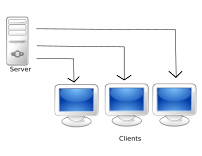
Diagram of Unicast Streaming
Image via Wikipedia

A few choice tidbits for those of you following our continual coverage of streaming video.

  • Netflix will offer Streaming-Only Plans. The company still remains focused on providing a bundled offering, but expects that some viewers will find a stand-alone streaming service to be compelling, particularly as more compatible devices become prevalent. Netflix streaming is already a feature of the Roku Netflix player, the Xbox, and some LG Electronics products. No word as of now on price.
  • Cable provider Comcast is in talks with its content providers and with other cable and satellite companies to discuss putting their programming online. The service would allow subscribers to watch shows online for free as soon as possibly this summer. It is seen as a preemptive strike against the possible loss of customers who opt to watch content online. One major issue in agreeing to an online service is the low level of revenues generated by Internet advertising compared to TV revenue. Comcast’s goal is to authenticate subscribers who go to certain sites, creating a “wall” behind which content providers may feel more comfortable releasing their materials.
  • On a related post, a commenter pointed out that with internet metering and bandwidth caps coming into fashion, these companies might induce usage of their services over others by not counting streaming from them against the meter.

Either way, interesting developments seem to be on the way. Keep posted…

Reblog this post [with Zemanta]
Published on February 25, 2009
Full Post
0 Responses

Fedora Unity Does a Release

Image representing Fedora as depicted in Crunc...
Image via CrunchBase

We’re devotees of Fedora Linux, despite alternatives, and the incredible popularity of Ubuntu, which we have spent some time with. But we started with Red Hat 7, and with Fedora as its successor, we know more of the ins and outs of this distribution.

Tonight, we’re using to Jigdo to assemble new DVD images, as the Fedora Unity project has released a Fedora 10 re-spin. For those of you not familiar with these things, some background.

Jigdo is a wonderful thing, and has been used by various Linux distributions for some time, and only recently as a method for Fedora distribution. The idea is this…a CD or DVD for a Linux OS is merely a compilation of various software packages and configuration files. Instead of downloading an entire image, Jigdo assembles it from its components. This has several advantages…for one it doesn’t tax any one site. Jigdo, given a mirror list, can download files from multiple sites to assemble its image.

The Fedora Unity Re-Spin is a Jigdo image of the standard Fedora installation media, using any updates that have been released since the original release. Thus, if you install Fedora 10 on a new system, you don’t then have to download a few hundred megabytes of updated files to each system. We maintain a local mirror we use to update multiple systems at one time, and using it and Jigdo, can assemble a new installation DVD in less than 5 minutes.

The glaring gap in the Fedora Jigdo release is that specialty Fedora spins are not released as Jigdo templates. Fedora offers LiveCDs and custom distributions of various types, and these are distributed only as ISOs.

Either way, the Re-Spin system is a good one, and Fedora Unity provides a service. For those of you still on Windows, check out this Lifehacker article on their equivalent, known as slipstreaming.

Reblog this post [with Zemanta]
Published on February 23, 2009
Full Post
0 Responses

Hulu Support in Boxee Disabled

Image representing hulu as depicted in CrunchBase
Image via CrunchBase

Hulu has announced that its content will no longer be available through Boxee. As they put it…

Our content providers requested that we turn off access to our content via the Boxee product, and we are respecting their wishes. While we stubbornly believe in this brave new world of media convergence — bumps and all — we are also steadfast in our belief that the best way to achieve our ambitious, never-ending mission of making media easier for users is to work hand in hand with content owners. Without their content, none of what Hulu does would be possible, including providing you content via Hulu.com and our many distribution partner websites.

Our mission to make media dramatically easier and more user-focused has not changed and will not change. We will not stop until we achieve it and we are sober in our assessment that we have such a long way to go.

Boxee writes that it has been pleading its case with Hulu’s content partners, but despite the positive feedback, they were unable to change their minds either.

i hope the content owners will realize boxee is their friend. we make it easy for people to access ad-supported TV Shows or use a subscription service like Netflix.  The reality is that if the content owners will not make it easy for users to get their content legally, then people will find other ways.

A lot of comments indicated people would go back to illegally downloading episodes via Bittorrent. Certainly not a good day for the future of television content online. We’re disappointed. We spent all this time promoting Boxee+Hulu as a really good content option. This cuts one of the best features. The XBMC Hulu Plugin has stopped working as well. Back to our wireless mouse and browser hack, we suppose.

Reblog this post [with Zemanta]
Published on February 18, 2009
Full Post
0 Responses

Some TV Stations Going All Digital Today

DTV Countdown Clock
Image by The Joy Of The Mundane via Flickr

As Crunchgear reminded us, today is the day of the original DTV transition date, and many stations are dropping their analog broadcasts today. These stations would have to pay money to keep these broadcasts on the air, including rental fees, and delays to contracts to dismantle equipment.

They also mention the usefulness of Antennaweb in setting up your broadcast antenna. We’ve tried it, and used one of their maps to try and aim a in-house antenna. There is an antique antenna on the roof of the building, which gets decent reception. But we have yet to get all of the channels an antenna our size is supposed to get.

Ultimately, in June, all analog will go away. Hopefully there will be no more delays.

Reblog this post [with Zemanta]
Published on February 17, 2009
Full Post
0 Responses

BoxeeBox

Boxee
Image via Wikipedia

Last week, the Device Guru website was temporarilly overloaded due to the syndication of one of its posts on Slashdot about building dedicated hardware to run Boxee. Boxee has been getting a lot of press, not just from us.

For those of you who haven’t been following it, Boxee is a complete media center solution based on XBMC, which it is an alternative for. Both provide an easy to install media solution with complete support for most video and audio formats, as well as streaming. Both have full plugin support, so you can extend it to support additional sites and online content, such as RSS-based media enclosures to follow podcasts.

Boxee takes it a step further by integrating flash-based players into its offerings, allowing it to offer full Hulu and other flash-based player site support controllable by a remote, although rewind and fast forward are apparently still buggy. XBMC has a Hulu-plugin that uses direct RTMP streaming. Since this eliminates the commercials, it means if it continues, Hulu will likely try to find a way to stop it, unlike the flash player method, which is fully supported.

Every month, Boxee seems to get support for a new site, such as ABC, BBC, etc. They even ask users to vote on what they want to see next.

That brings us back to Device Guru, who detailed his goal of building a sub-$500 IP-STB(Internet protocol set-top box), essentially something with the form factor of a piece of dedicated hardware, ie dvd player, stereo, etc, and capable of delivering a/v content to a TV/entertainment system/home theater without monthly cable fees and such. One can get some dedicated prebuilt boxes to do this, including the AppleTV, which Boxee has ported its software to, but there are advantages to building a small form-factor computer and loading Boxee, XBMC, and whatever else you want to use into it.

The DeviceGuru uses an Intel MicroATX motherboard, and an ultra-slim case. You can go for a Mini-ITX motherboard, and go even smaller. But if you want room for extra memory, firewire, DVI/HDMI, digital sound, etc., and the horsepower to decode and playback HD video, you may need the extra throttle.

Boxee, as well as XBMC, runs best on Ubuntu Linux, and thus all the software is free of charge. Get yourself a USB remote, set Boxee to autorun on startup, and your device will be indistinguishable from a DVD player.

We have a media player of our own, but we opted for a MicroATX cube, like Device Guru’s, from Silverstone. The SG-02. It uses a normal power supply, and has enough room for high-end video cards and hard drives with a moderate sized form factor. We have another cube made by Antec.  They move well, they allow us to use spare parts from other systems to upgrade, and for flashy effect, we added in a Crystalfontz front display. Many home theater PC cases, designed to be integrated in this manner, include displays for displaying the currently playing program, and there is display support in XBMC for them.

Either way, for a variable amount, less if you have some spare drives, you can build a media center that will integrate internet and computer based video into your entertainment center. And it will offer a unique selection of items, many of which you cannot find on cable.

Reblog this post [with Zemanta]
Published on February 16, 2009
Full Post

Get New Posts By Email