Gadget Wisdom

Author: David Shanske

Registration time

2011-09-25 06:23:49

Website

https://david.shanske.com/

Email

david@shanske.com

All posts by David Shanske

1 Response

Google Music vs. Amazon Cloud Drive – Some Limitations

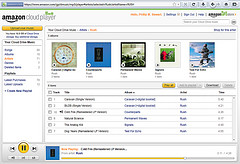
Amazon Cloud Player
Image by pmsyyz via Flickr

Out of the various online music lockers that are springing up, Google Music seems to have the best interface for metadata. This is especially important if you intend to be able to sort through your music. This is why, despite supporting Moozone, we decided to upload our music to multiple clouds. In terms of user experience, Google wins hands-down.

Amazon Cloud Drive, by comparison, seems to offer no ability to edit the metadata, which affects playback and search. It makes the experience a bit harder. Their web player is not very feature filled and their Android app is equally lacking in aesthetics. Google Music could use more functionality, but it offers a compelling set of features.

Amazon makes it easy to download files, Google does not. You can make files available offline in the Android app, but you can’t download them. So it isn’t a backup solution.

Neither company offers a public API, so third-parties can expand their offerings, however. Amazon Cloud offers a free and paid product. Google has yet to offer a paid product, and it may or may not.

We’re still on the fence about this. Ironically, we prefer the Amazon music to the Google Music store, but Google has the better interface. And neither supports OGG, unfortunately. But, so far, in this battle, Google has won. But we often find ourselves using Amazon’s MP3 App for Android right after we’ve bought a song. Something to be said for ease of use.

What do you think?

Published on December 30, 2011
Full Post
1 Response

Making and Receiving Calls Overseas

Image representing Google Voice as depicted in...
Image via CrunchBase

For many of us, our phone usage has migrated from voice to text and data. Few phone calls are made. So, this means, either the higher costs of making a call are not an issue, since you will not make many calls, or you need an alternate solution.

Enter…at least for Android users, GrooveIP. (Market Link) GrooveIP, in conjunction with Google Voice, lets you make and receive calls using data on your phone. You set your Google Voice account to forward to a Google Chat account.

Google Voice is currently free to use for calls to the U.S. or Canada and will remain so through 2012. Rates to landlines in other countries are reasonable at less than 10 cents. To Cell Phones abroad, it is somewhat more costly.

For us, on our recent trip, we were able to use GrooveIP and Skype to make and receive calls as if we were in the United States. Some people, aside from some tinniness on the line, had no idea we were even out of the country.

The common international alternative is Skype. Skype offers pay per minute and subscription plans. However, like Google Voice, the charges to mobile numbers in countries other than the U.S. or Canada are more expensive, and not included in their subscription plans.

To be fair, we have to remind you that neither of these are 100% alternatives for landlines or mobiles, as they do not provide 911 emergency support. But most carriers, even if you do not pay for service, allow emergency calls.

For text messages, Google Voice also offers free text messages sent and received. There are similar apps that can be used elsewhere.

It is why the future of voice for cellular phones, as has been gradually shifting for landline phones, is VoIP. But, like in many other industries, carriers will do the best to hold onto their business models instead of pivoting into new ones.

More on this to come…

Published on December 27, 2011
Full Post
1 Response

The Last Nail in the Boxee Coffin

“In an Internet/on-demand world your primary concern is the quality of your content, since you are held accountable by the consumer.” – Avner Ronen, CEO, Boxee, 2009

Version 1.5, just released, of the popular media software, Boxee, will be its last for the PC.

Image representing Boxee as depicted in CrunchBase
Image via CrunchBase

We believe the future of TV will be driven by devices such as the Boxee Box, Connected TVs / Blu-Rays and 2nd screen devices such as tablets and phones. While there are still many users who have computers connected to their TVs, we believe this use case is likely to decline as users find better alternatives. People will continue to watch a lot of video on their computer, but it is more likely to be a laptop than a home-theater PC and probably through a browser rather than downloaded software.”

Boxee started with community support. We showed up at every Boxee NYC event. Nearly a year ago, we asked if Boxee had ‘sold out‘. They had slowed their PC development to a crawl, and now they are releasing a final version, after which they will focus solely on their embedded hardware. There are complaints about numerous firmware issues on their hardware.

We threw a lot of support behind Boxee early on, because they seemed to understand the HTPC hobbyist. They started with trying to create a seamless and social experience based on top of XMBC, an open-source media center with extensible plugins. We understand the needs of a business to make money, but each decision has been a nail in the coffin. There are many less expensive options for streaming. Roku boxes start at $50. Many of these features are integrated into TVs and Blu-Ray players.

Boxee may have missed its chance, and is floundering for a way to succeed. We can say we are very disappointed. We still remember when Boxee CEO Avner Ronen had a very public debate with Mark Cuban about the future of video, from which the quote at the top of this article appears. Ronen was referring to cable providers, but he should remember his own words:

The concern should be quality, for you are held accountable by your consumers. 


Published on December 27, 2011
Full Post
3 Responses

Improving the Blog: Full-Text vs Summary Syndication

Here at Gadget Wisdom we are testing distributing full text of our posts over RSS. This will be available to you in your feed reader.

English: This icon, known as the "feed ic...
Image via Wikipedia

Every so often, we spend some time doing a redesign of sites to see if they can be any better. None of the things we are putting in are revolutionary. What we really want out of all of them is increased participation in our sites. Over the 5 years we’ve been blogging, we’ve always wanted to produce more interaction with readers. We enjoy the topics we write about.

In researching improvements, there were a lot of points for and against full-text feeds. The biggest risk is that others would scrape our content and place it on other sites. To that end, we’ve added a link to our site at the bottom of every feed. We may take more measures. We, like most, want to protect what we’ve written from being used by others without attribution.

To those of you who use feed readers, we hope you will enjoy the improvement. You can add it to your favorite feed reader and read without interruption. We know how much people hate truncated content.

This also allowed us to release Gadget Wisdom to Google Currents. You can subscribe here(http://www.google.com/producer/editions/CAow4NsZ/gadget_wisdom). We’ll see how that works as well.

We’d love to hear your thoughts on how we might protect ourselves from being scraped by other sites, and how we might improve your experience here at the Weneca Media Group collection of sites. There is more to come.

Published on December 16, 2011
Full Post
2 Responses

Preparing Your Phone for Global Use

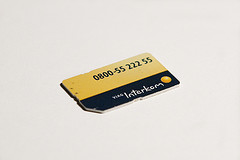
dead SIM
Image by Yaisog Bonegnasher via Flickr

Back in October, we discussed some of the thoughts we were having regarding smartphone use abroad. Now we’re back to talk about how it played out.

We’re Verizon customers, and Verizon Wireless is a CDMA carrier. The majority of the world uses GSM. One of the things about GSM versus CDMA is that GSM uses a SIM card. SIM, or Subscriber Identity Module. The SIM card is tied to the network, as opposed to the phone itself. You can thus move the card in between phones, and thus the number. There is a CDMA equivalent, but it is not currently used in the United States. SIM cards are also used on the LTE network that Verizon used

This was surprisingly easy, but you can’t do it at a store. We tried. You have to call Verizon Global Support(1-800-711-8300), as opposed to regular tech support. They will allow one unlocking per line every ten months, as long as you have been a customer in good standing for at least sixty days. We unlocked multiple global phones, even ones not being brought along, as long as we were on the phone with them. To ensure this works, have a SIM card ready to test before you leave. We used a $5 Telestrial Passport Lite to do this.

AT&T is apparently not as cooperative. You can always buy a fully unlocked phone, but that will be at an increased price.

There are other options to be aware of. If you frequently switch between countries and providers, there is such a thing as a dual SIM adapter, which would allow installation of two SIMs at once. We have yet to try one of these, but it is said you can switch them in software, with an Android phone. There are also card adapters that will, if put inline with a SIM card will allow it to work on a locked phone.

Now that your phone can be used anywhere, you need to start researching options in the country you wish to travel to. If you go there frequently, it makes sense to have a contract. But if this is an infrequent trip, such as a few times a year, or a one-off, you can visit PrePaidGSM.net for some advice. Their forums and pages provide a chance for you to get firsthand advice and experience.

From all the research we did, it seems that the best move is to try and secure a SIM card locally after arrival. There are companies that will provide international cards, or will provide international cards, but they often offer less favorable deals, or at an increased cost. Most international airports nowadays have shops that sell prepaid SIMs and will set it up for you.

If data is more important to you than voice, then you can always turn off the radio in your phone and use wifi only. Although finding wifi hotspots may also be an issue, depending on where you are.

What have you done in the past to maintain your need for cell?

Published on December 9, 2011
Full Post
0 Responses

Why are People Against the Kindle Fire?

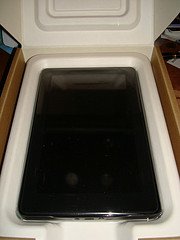
Amazon Kindle Fire in the Box
Image by IslesPunkFan via Flickr

Last week, we picked up a Kindle Fire. It was a ‘gift’ for an older relative. But, in the name of ‘configuring’ it, we played with it for three days before delivering it. The Kindle Fire is a great device. We’re not sure why tech writers are coming out against it left and right.

The Kindle Fire is a solid device, solid enough it doesn’t really need a case. It has two small speakers, a headphone jack, a USB connector, and a power button. Simple and good. The headphone jack allegedly supports an external microphone, although the Appstore is not aware that it is sound capable.

The Amazon Appstore offers a good selection of apps, but not everything. We could live without the Android Market, although we paid for a lot of apps there we want to use. But we immediately side-loaded Gmail and the Google Services Framework, which can be installed without root access. If you are a Google mail user, apps or gmail, the Gmail app is superior to most third-party email apps, as it is customized.

The fact that the Amazon Video app is not available in the Appstore for non-Fire use is a mistake on Amazon’s part. Even if it is just for the streaming part, and not offline store and play. We tried downloading a few things, and see this as a great feature, if you are willing to buy.

In the end, handing it to an older relative, we preloaded it with Gmail, with dozens of Kindle books, with music, by hooking it into the Amazon account. We also loaded up some of their favorite apps from their cell phone. And while it is limited compared to their phone, the bigger screen makes it easier for them to read and do related surfing and apps. And it plays Wordfeud wonderfully…and if that is what you want…it’s great.

The one big annoyance is the carousel in the launcher. Visually it is pleasant, but anything you do ends up in this carousel and you can’t customize or remove it. Better off installing a ‘real’ Launcher.

Not everyone wants or needs a fully featured tablet. You can live without GPS, bluetooth, etc, if they aren’t things you need in daily life, and be perfectly happy.

Published on November 28, 2011
Full Post
3 Responses

Kindle Fire isn’t a Full Tablet, but the Price is Right

NEW YORK, NY - SEPTEMBER 28:  Amazon founder J...
Image by Getty Images via @daylife

Everyone wants to compare the Kindle Fire to the iPad, or some other tablet. The truth is…it isn’t comparable. But for those interested in owning a tablet, it is a good solid option at an affordable price.

The Fire runs a stripped down version of Android 2.3, but we predict that the hacking will commence immediately, and with the recent release of the Ice Cream Sandwich source code, someone will quickly enhance the software side of things.

We did not buy a Kindle Fire, but it might be a consideration as a gift. It is a great option as a media consumption device. Magazines, videos, music…all are customized around Amazon’s media offerings.

Whatever you can say about Amazon, they offer a good variety of media services, and if you pay for Amazon Prime($79/yr), you will not want for videos to watch, even if they are not current blockbusters, Amazon is committed to adding new content.

If we do get a Fire, we’ll have more on this. In the meantime, there are a lot of reviews out there. The bottom line, it is a good product for the price, and a great entry into the tablet world. If you are trying to compare it to an iPad, which is several hundred dollars more, the comparison is flawed.

We own a Nook Color, which we’ve hacked into a full fledged Android tablet. The new Nook Tablet is pretty much, except for the guts, identical to the old. It is the closest comparison to the Kindle Fire. To be honest, Amazon is offering a more integrated experience, but the Nook Tablet offers its own advantages.

Published on November 15, 2011
Full Post
2 Responses

Adventures in Global Smartphone Travel – Call for Feedback

For use on the English Wikipedia page LG Ally
Image via Wikipedia

Recently, we started making plans to travel out of the country for the first time since most of us here at the Weneca Media Group got a smartphone.

Since that time, the advice given about smartphones(once you get one, it is hard to go back), has rung true. The idea of being without one and its instant data access wherever we go seems a strange one.

However, most of us have selected a CDMA carrier. Mostly Verizon, but Jere over at Android Buffet has a Sprint phone. The majority of the world uses GSM as its standard, rendering these phones useless. However, Verizon offers a limited series of global phones, including the Droid 2 Global and the Droid 3, both available in the Gadget Wisdom collection.

So, our conversation started with Verizon. Despite the fact Vodafone owns nearly half of Verizon, they do not offer a good deal on data. Signing up for a 50MB plan is $30.

Looking around at prepaidgsm.net, which summarizes rates around the world for prepaid gsm, there are better deals to be had. The downside is that you can’t keep your U.S. number, but we’ll get to that in a moment.

As a Verizon customer, we would need to unlock our Global phones. Verizon Global Tech Support advised they would unlock one phone every ten months for a customer in good standing. The phone would have had to have been on the account at some point. So, time to decide which phone is going overseas. Perhaps the one not being used in daily life…

If we wanted to chuck all data concerns out the window, Telestial offers inexpensive prepaid world SIM and prepaid phones, and can be purchased through Amazon. They offer both a U.S. and a U.K. phone number, with cards starting at $5. We may get one of these as a backup.

Our plan is to go for something decoupled from the phone for the U.S. issue, Skype. Skype offers a service called Skype-To-Go numbers. They will assign a number that will forward to an overseas number at your expense, which is significantly less than the cost of having same done by a phone company. You can even forward your normal or Google Voice number to this number, making it seamless for friends and business associates. It would also, if we set it up after arriving and purchasing a prepaid SIM card, allow us to use the cheap local plans, instead of other options.

What do you think? We haven’t done any of this yet, but what do you suggest?

Published on October 18, 2011
Full Post
0 Responses

Are Bookshelves No Longer for Books?

MUNICH, GERMANY - APRIL 02:  Lars Dafnas,  hea...
Image by Getty Images via @daylife

The LA Times questioned the future of paper books, based on the information that the classic Billy Bookcase is being redesigned. Next month, the shelf will be rereleased as a deeper shelf, meant to display decorative items, and is already pushing glass doors as an add-on.

Our perspective is probably interesting, as a previous Ikea redesign on the Billy Bookcase, which is over thirty years old, halted our expansion plans. We had invested in Billy with the idea we could gradually add to it. Unfortunately, they discontinued the color, if not the bookcase.

As for the fact that over ten percent of the population now has an E-Reader, we addressed the issue of gradually decluttering your space with an E-Reader. When we first brought in the Billy Bookcases some years ago, there were three of them. We’ve since eliminated one by gradually going digital. But there are some books that we will never get rid of.

For most people, while e-readers may mean a slowdown in the purchase of paper books, it does not mean a complete elimination. For one, too many materials aren’t available electronically. E-Books are not transferable, nor can you buy them cheap used. Thus there are limits to their utility and we doubt they’ll ever completely go away, and we don’t want them to. Our prediction is that the publishing industry will migrate to a print-on-demand model. There may still be trade paperbacks printed, but if you want a copy of the majority of books, they will print it on request.

As we write this, we paused at this moment to turn around and look at the Billy behind and wonder about the future. The Billy we got rid of, we did add in a smaller bookcase which is filled with movies. Is the future visual and audio entertainment, over the written word? Maybe books of all kinds are on the way out.

If they aren’t, will we read on e-ink screens? Tablets?

Many people prefer a dedicated e-reader not just because e-ink screens tend to be less harsh on the eyes than LCDs, but because they have the same distraction-free nature as books. They aren’t designed for multiple streams of information. They allow you to focus on the book.

There are many kinds of people in this world. We all have different needs. Some are better with audio, some better visually…the newest generation has been conditioned to learn best with multimedia. There will always be demand for printed material, even as things change.

But that’s us. What do you think?

Published on September 11, 2011
Full Post
0 Responses

Making a Decision on Music

Music guitar
Image by doug88888 via Flickr

Recently, Google, Apple, and Amazon all got into the Cloud Music business. We tried Google and Amazon out, and decided on a lesser known service called Moozone. Moozone natively supports Ogg Vorbis, a format we use, and it even supports true Ogg streaming at up to 500kbps.

Lesser known companies often have the chance to offer features that would not work in the mainstream. Google Music supports Ogg, but it encodes it to MP3.

It offers the same advantage as Amazon…namely that you can buy songs and the storage will be provided for them at no extra charge. But unlike Amazon’s service, which is rental based, Moozone allows you to buy storage at a flat rate.

Moozone has problems though. It was launched in beta in 2009, released an Android app in January of 2010. At the same time, Moozone signed with MediaNet in order to provide additional music sales. In the last year, there has been little change though, and Amazon, Google, Apple, etc have all launched cloud music storage.

While we appreciate the resources that a large corporation can put behind a service, smaller companies can offer attractive niche features. Take MP3tunes, started by the man behind MP3.com, which got sued out of existence. It offers an open API, support on a variety of hardware devices, etc.

We love to support the underdog, and we’re hoping we didn’t gamble on the wrong company. Either way, never put all your horses in one basket.


Published on July 31, 2011
Full Post

Get New Posts By Email