
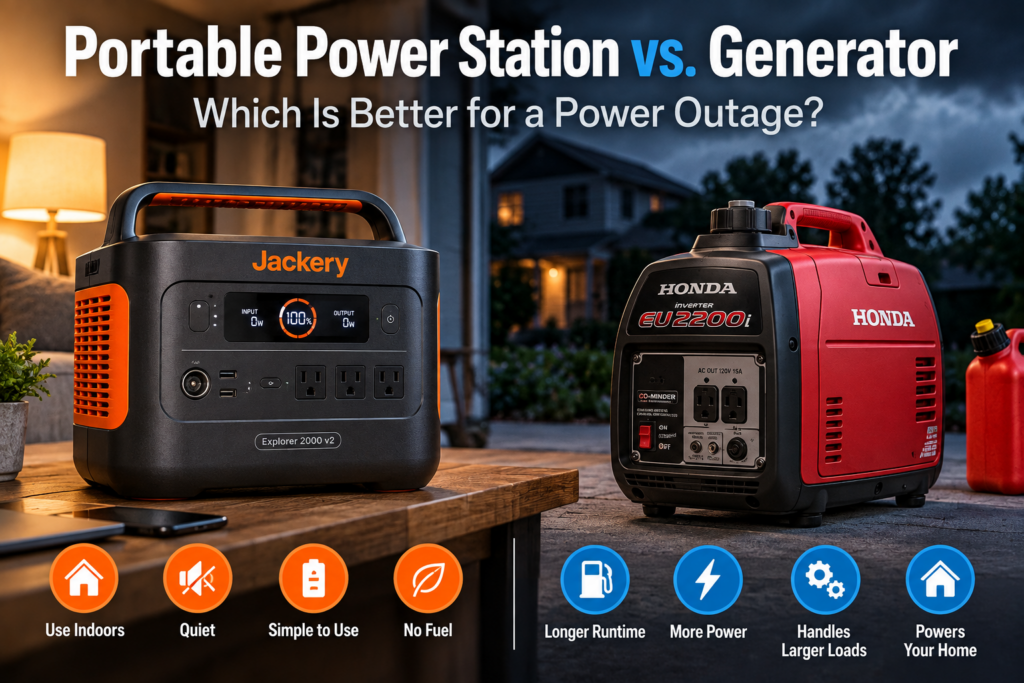
If you are buying backup power for a home outage, the easiest mistake is to compare the biggest watt numbers on the boxes.
A 2,200-watt portable power station and a 2,200-watt generator sound as though they should do roughly the same job. They do not.
A portable power station stores a finite amount of electricity in a battery. A generator converts fuel into electricity while it is running. The battery is quiet, simple to use and produces no combustion exhaust. The generator requires fuel, maintenance and a safe outdoor operating location, but it can keep producing electricity long after a battery of similar price and size has been emptied.
That leads to the question that actually matters:
What do you need to keep running, for how long, and do you have a safe place to operate a generator?
For an apartment, a shorter outage or a refrigerator plus electronics overnight, I would often rather have a portable power station. For a multi-day outage, a well pump, substantial 240V loads or much more of the house, a generator becomes considerably harder to replace.
For some homeowners, the best answer is not battery or generator. It is both.
Portable Power Station vs. Generator: The Short Answer
| Situation | Usually the Better Choice |
|---|---|
| Apartment or condo | Portable power station |
| Outage lasting a few hours | Portable power station |
| Quiet overnight backup | Portable power station |
| Refrigerator, lights, phones and internet equipment | Usually portable power station |
| CPAP and modest overnight loads | Usually portable power station |
| Multi-day outage | Usually generator |
| No safe outdoor generator location | Portable power station |
| Need to replenish power quickly during a long outage | Generator |
| Large 120V or 240V household loads | Larger generator or substantially larger battery system |
| Selected house circuits through transfer equipment | Large generator or purpose-built home battery system |
| Want quiet power plus long-duration backup | Battery + generator |
Watts and Watt-Hours Are Not the Same Thing
This is the key to understanding the entire comparison.
Watts measure how much power a device is using or a power source can deliver at a particular moment.
Watt-hours measure energy over time. On a battery, watt-hours tell you roughly how much electricity is stored.
The Jackery Explorer 2000 v2, for example, stores 2,042Wh and can deliver up to 2,200W of continuous AC output.
The Honda EU2200i has a remarkably similar maximum output number: 2,200W, with 1,800W rated continuous output.
Yet the Jackery contains a little over 2kWh of stored electricity. Once that energy is gone, it must be recharged.
The Honda does not have a comparable fixed energy capacity. It produces electricity by burning gasoline. When its tank is empty, the engine can be shut down, allowed to cool and safely refueled. With additional fuel available, it can continue producing electricity.
So two products with “2200 watts” prominently attached to their names can behave very differently during the second or third day of an outage.
How Long Does a 2kWh Portable Power Station Last?
A useful first estimate is:
usable battery energy ÷ average load = approximate runtime
You should not simply divide the advertised battery capacity by the appliance wattage and assume every stored watt-hour reaches the appliance. The inverter, electronics and battery-management system consume some energy, and efficiency changes with the load.
For rough outage planning, suppose we use a conservative 85% usable-AC assumption for a 2,042Wh battery. That leaves about 1,736Wh available to the connected AC loads.
| Average Load | Approximate Runtime at 1,736Wh Usable |
|---|---|
| 50W | About 35 hours |
| 100W | About 17 hours |
| 200W | About 8.7 hours |
| 500W | About 3.5 hours |
| 1,000W | About 1.7 hours |
Those are planning examples, not manufacturer runtime guarantees. Real appliances cycle on and off, inverter efficiency varies, batteries behave differently with temperature and load, and startup surges can matter even when average consumption is modest.
A refrigerator illustrates the problem nicely. Its compressor may draw substantially more power when running than the refrigerator averages over an entire day. If the compressor runs only part of the time, estimating runtime from its maximum running wattage can be far too pessimistic.
If an appliance matters enough that you are buying backup power specifically for it, measuring its actual consumption is much better than relying on a generic internet wattage chart.
Where a Portable Power Station Wins
It does not produce combustion exhaust
A battery power station does not burn gasoline or propane. That eliminates the carbon-monoxide problem created by an engine-driven generator.
Portable power stations can generally be used inside when operated according to the manufacturer’s instructions, including their temperature, moisture, clearance and ventilation requirements. They are still large lithium-battery systems and should be treated as electrical equipment, not as indestructible boxes you can leave anywhere.
But from an outage-planning perspective, being able to bring your backup power to the refrigerator, bedroom or network equipment without running a combustion engine is an enormous advantage.
It is much quieter
A portable power station may run cooling fans, particularly at higher loads or while charging, but it does not have an engine running outside all night.
That makes batteries particularly attractive for overnight refrigeration, internet equipment, lights, phones, laptops, CPAP machines and other moderate loads.
It starts instantly
If the battery is charged, there is very little outage-day setup. Plug in the equipment you need and turn on the appropriate output.
There is no gasoline to pour, oil level to check, engine to start or outdoor extension-cord route to establish after the lights have already gone out.
It may be the only realistic choice in an apartment
If you live in an apartment, condominium or dense urban setting without an appropriate outdoor location, a combustion generator may not be a practical option at all.
A power station gives renters and apartment owners access to a meaningful amount of backup electricity without needing a yard or generator installation.
Two 2kWh Portable Power Stations I Would Consider
For meaningful home-outage backup, I find the roughly 2kWh class much more interesting than the small camping batteries often marketed as emergency power.
Two current models illustrate different approaches particularly well.
Jackery Explorer 2000 v2: The Simpler, Lighter 2kWh Option
The Jackery Explorer 2000 v2 packs just over 2kWh into a surprisingly manageable package.
- 2,042Wh LiFePO4 battery
- 2,200W rated AC output
- 4,400W instantaneous peak output
- Three AC outlets
- 39.5 lb
- Up to 400W DC/solar input
- 100W USB-C output plus additional USB outputs
- Jackery rates the battery for 4,000 cycles to at least 70% remaining capacity
Its biggest advantage is portability for the capacity. At 39.5 pounds, it is not something I would want to carry casually all day, but it is still a one-person lift for many buyers.
Its biggest limitation is equally clear: the Explorer 2000 v2 does not support expansion batteries. The capacity you buy is the capacity you have.
That is not necessarily a problem. If the goal is a straightforward battery that can move between a refrigerator, electronics, camping trips and emergency use, the lack of a larger battery ecosystem may not matter.
I would choose the Jackery if: I wanted a relatively light, straightforward 2kWh unit and did not expect to expand it into a larger battery system later.
Check the current Jackery Explorer 2000 v2 price on Amazon
Anker SOLIX C2000 Gen 2: Better If You Might Expand
The Anker SOLIX C2000 Gen 2 begins with almost exactly the same battery capacity but takes a more expandable approach.
- 2,048Wh LiFePO4 battery
- 2,400W continuous AC output
- 4,000W peak output
- 41.7 lb
- Up to 800W solar input
- TT-30 outlet in addition to standard AC outlets
- 10ms specified UPS transfer time
- Expansion with one 2,048Wh BP2000 Gen 2 battery for roughly 4kWh total capacity
- Anker rates the battery for 4,000 cycles
The solar input is especially interesting for the backup-power use case. An 800W input ceiling does not mean you will collect 800W from panels all day, but it gives you considerably more potential replenishment than a 400W input limit when sunlight and panel conditions cooperate.
The expansion port also changes the long-term decision. You can start with about 2kWh and later add another roughly 2kWh without replacing the original unit.
Expansion increases stored energy, not the inverter’s continuous output. A larger battery lets a given load run longer; it does not magically turn a 2,400W power station into a 5,000W power source.
I would choose the Anker if: I wanted a 2kWh unit now but cared about expansion, faster solar replenishment or RV-style connectivity later.
Check the current Anker SOLIX C2000 Gen 2 price on Amazon
Where a Generator Wins
The outage lasts longer than the battery
This is the central generator advantage.
A 2kWh battery may be excellent for an evening, overnight or carefully managed collection of critical loads. But if the grid is still down after the stored energy is gone, you need a way to put energy back into it.
That might be utility power, solar panels, a vehicle charging system or another battery.
Or it can be a generator.
With an adequate fuel supply, a generator can continue producing electricity through an outage that lasts for days. You still have to store fuel safely, maintain the engine and refuel according to the manufacturer’s instructions, but total energy is no longer limited to whatever was inside a battery when the outage began.
You have larger loads
A 2,200W or 2,400W battery power station can run considerably more than a phone charger and a lamp. But there is a large gap between “power several important appliances” and “power a significant portion of an electrically demanding house.”
Central air conditioning, large well pumps, electric water heaters, electric cooking equipment, electric dryers and combinations of major appliances can quickly overwhelm a small portable battery.
A larger generator can supply several times as much continuous power.
You need 240V
This is an important limit that is easy to miss when people shop only by wattage.
The Jackery Explorer 2000 v2 and Anker SOLIX C2000 Gen 2 discussed here are 120V portable power stations. Some household equipment requires 240V.
The Westinghouse generator farther down this article provides 120/240V output. That moves it into a very different home-backup class.
Honda EU2200i: What a Small Generator Does Better
The Honda EU2200i is useful in this comparison because its maximum watt rating is almost identical to the Jackery’s continuous output.
- 1,800W rated output
- 2,200W maximum output
- 120V inverter generator
- 0.95-gallon gasoline tank
- Honda rates runtime at about 3.2 hours at rated load
- Honda rates runtime at about 8.1 hours at one-quarter load
- 47.4 lb dry weight
- 48 to 57 dB(A), depending on load
- CO-MINDER carbon-monoxide monitoring/shutoff system
Notice what is strange about that comparison.
The Jackery actually has a higher continuous output rating: 2,200W versus the Honda’s 1,800W.
But the Honda can produce far more total energy during a long outage because you can supply additional gasoline. A second gallon of fuel extends the useful life of the generator. There is no equivalent way to pour another kilowatt-hour into an empty non-expandable Jackery.
This is why watt ratings alone are such a poor way to decide between batteries and generators.
I would choose the Honda if: my loads were modest but the outage could last long enough that a 2kWh battery would clearly be insufficient.
Check the current Honda EU2200i price on Amazon
Westinghouse iGen12000DFc: A Completely Different Class of Backup Power
The Westinghouse iGen12000DFc is deliberately not a close competitor to the two 2kWh batteries above.
It shows what happens when the goal changes from powering a collection of essentials to supplying serious household backup power.
- 9,000W running / 12,000W peak on gasoline
- 8,100W running / 11,000W peak on propane
- 120/240V output
- Dual-fuel gasoline and propane operation
- 7.9-gallon gasoline tank
- Up to 19 hours at 25% load on gasoline, according to Westinghouse
- About 11 hours at 50% load on gasoline
- About 9 hours at 25% load on a 20 lb propane tank
- About 5 hours at 50% load on a 20 lb propane tank
- Less than or equal to 3% total harmonic distortion
- 120/240V 50A and 30A outlets suitable for properly configured transfer equipment
- CO sensor with automatic shutdown
- Electric, remote and recoil starting
- 189 lb dry weight
This is not something you casually carry to the refrigerator. At nearly 190 pounds before fuel, it is portable in the generator sense: it has wheels and can be moved into position. It is not portable in the same sense as a 40-pound battery.
What you gain is a radically larger power envelope.
At 9,000 running watts on gasoline, the iGen12000DFc can potentially support combinations of household loads that make little sense on a 2,000Wh portable battery. Its 240V capability also opens the door to equipment the Jackery and Anker examples here cannot directly power.
That does not mean every house can simply plug in and run normally. Whether a generator can support your home depends on the actual loads, their startup requirements, how circuits are connected and what is running simultaneously.
I would choose a generator in this class if: I wanted to move beyond extension-cord backup for a few appliances and toward substantial selected-circuit home backup, with the electrical connection designed correctly for the house.
Check the current Westinghouse iGen12000DFc price on Amazon
Portable Generator Safety Is a Major Part of the Buying Decision
A generator’s long runtime is extremely useful. The tradeoff is that you are operating a combustion engine during an emergency.
Carbon monoxide is the most important danger.
The U.S. Consumer Product Safety Commission’s current guidance says portable generators should be operated outside only, at least 20 feet from homes and buildings, with the exhaust directed away from windows, doors and vents.
Do not run a generator in a house, basement, shed, crawlspace or garage. An open garage door does not make an attached garage a safe generator location.
The CPSC also recommends working carbon-monoxide alarms on every level of the home and outside sleeping areas.
You can read the agency’s current guidance here: CPSC generator and carbon-monoxide safety guidance.
Both generators in this article have automatic CO-monitoring shutdown systems. Those are valuable safety features. They do not make it safe to operate a generator indoors or too close to a building.
Do Not Backfeed Your House Through a Wall Outlet
A large generator such as the Westinghouse becomes much more useful when it can supply selected household circuits, but this needs to be done correctly.
Do not try to energize your house by connecting a generator to an ordinary wall receptacle with a male-to-male cord. This practice, usually called backfeeding, can create electrocution and fire hazards and can energize utility-side wiring unexpectedly.
The CPSC specifically warned again about these cords in 2026.
If a generator will feed household wiring, use appropriate transfer equipment or an approved interlock arrangement installed for the application. Have a qualified electrician determine what is appropriate for your panel, generator and local code requirements.
That is an additional cost compared with carrying a battery to an appliance, but it also creates a much more useful home-backup system.
What About a Refrigerator?
A refrigerator is one of the most compelling uses for a 2kWh portable power station.
Food preservation matters during an outage, but refrigerators do not necessarily consume their full running wattage continuously. The compressor cycles.
A battery therefore may provide much more useful refrigerator time than you would guess from looking only at a compressor’s running wattage.
The catch is startup surge. Compressors can briefly demand substantially more power when they start.
Before assuming any battery will run your refrigerator, check the actual appliance and ideally measure its consumption. The same principle applies to freezers.
What About a Sump Pump?
Sump pumps are another attractive outage load, but they are more demanding than their normal running wattage can suggest.
The motor may require a sizable startup surge each time the pump starts. A pump that appears to fit comfortably within a power station’s continuous output can still exceed its surge capability.
Runtime also depends on something you cannot know from the pump’s wattage alone: how often it has to run. During a major storm, that may be much more often than during normal weather.
If a sump pump is the reason you are buying backup power, size around the actual pump and a reasonably bad water-inflow scenario rather than an average day.
What About a Well Pump?
Well pumps deserve extra scrutiny because many are 240V loads.
If your well pump requires 240V, neither the Jackery Explorer 2000 v2 nor the Anker SOLIX C2000 Gen 2 in this article can directly power it from their 120V AC outputs.
A 120/240V generator such as the Westinghouse may be a much more natural fit, assuming its capacity and the home’s electrical setup are appropriate for the pump.
Can a Portable Power Station Run an Air Conditioner?
Sometimes.
A small window air conditioner is a very different load from a large central-air system. Compressor startup demand matters, and even an air conditioner that a 2kWh battery can successfully start may drain that battery rapidly.
There are portable battery systems much larger than the two examples here, including expandable systems designed around 240V home backup. At that point, however, you are no longer comparing a $1,000-ish portable battery conceptually with a small generator. You are designing a substantially larger energy system.
Electric Space Heating Changes the Math Very Quickly
Resistance heat is one of the fastest ways to empty a portable battery.
A 1,500W space heater running continuously would theoretically consume 1.5kWh every hour before accounting for inverter losses. A 2kWh battery is therefore a poor long-duration substitute for ordinary electric heat.
If winter outage preparation is the goal, consider the power demands of the home’s actual heating system. A gas or oil furnace may need only enough electricity for controls, ignition and a blower, while electric resistance heating can require vastly more energy.
Solar Panels Help, but They Do Not Make a Battery Infinite
The phrase “solar generator” makes this part of the market sound more magical than it is.
A solar panel is a way to put energy back into the battery. Whether it replaces energy as quickly as you consume it depends on panel capacity, weather, season, shade, orientation and the power station’s input limit.
The Jackery Explorer 2000 v2 accepts up to 400W of DC solar input. The Anker SOLIX C2000 Gen 2 accepts up to 800W.
Neither number means you will receive that output continuously from sunrise to sunset.
Imagine your essential loads consume 3kWh per day and your panels produce only 1.5kWh that day. Solar has extended your outage runtime substantially, but the battery is still losing a net 1.5kWh per day.
On a clear day with an appropriately sized array, the equation may look much better. In miserable storm weather, it may look much worse.
This is why foldable solar deserves its own buying decision rather than being treated as a free infinite-fuel attachment to every power station.
Why Battery + Generator May Be the Best Home-Outage Combination
The more I think about backup power, the less I view batteries and generators as natural enemies.
They are good at almost opposite things.
A battery is excellent for:
- quiet overnight power
- internet and network equipment
- refrigerators and freezers
- lights
- phones and laptops
- short interruptions
- indoor loads where an outdoor generator would be inconvenient
- instant power without starting an engine
A generator is excellent for:
- outages lasting days
- larger loads
- 240V equipment when the generator supports it
- selected household circuits through properly installed transfer equipment
- replenishing batteries when solar or grid charging is unavailable
That creates a surprisingly sensible hybrid system.
You can use the battery during quiet periods and overnight. Run the generator when larger loads need power or when the battery needs to be replenished. Then shut the engine down again instead of listening to it run for hours merely to support a refrigerator, router and a few lights.
This arrangement does cost more because you are buying two forms of backup power. But it also reduces the need to force either one to do a job it is poorly suited to do.
Where a UPS Still Fits
A portable power station does not replace a UPS.
A UPS solves a different problem: maintaining power automatically when electricity disappears for a moment, protecting equipment from interruption and giving electronics time to ride through an outage or shut down properly.
If your concern is keeping a router and modem alive through short outages, see my guide to the best UPS for a router and modem.
For larger home networks, NAS devices, PoE cameras and switches, I have a separate guide to the best UPS for a network closet, NAS and PoE equipment.
A portable power station becomes interesting when the problem has moved beyond “don’t let this reboot” and toward “I want meaningful stored electricity for hours.”
There is one more wrinkle for internet backup: supplying electricity to your modem and router does not guarantee that your ISP’s equipment upstream from your house still has power. I cover that in Will Your Internet Work During a Power Outage?
What I Would Buy for Different Outage Scenarios
Apartment or condo
I would buy a portable power station.
Unless you have an unusually suitable outdoor setup and building rules that permit it, the generator’s exhaust and placement requirements make it a poor fit.
House, mostly worried about short outages
I would start with a roughly 2kWh power station.
For a refrigerator, network equipment, phones, lights and other modest loads, it provides useful backup without turning every outage into a small-engine project.
The Jackery Explorer 2000 v2 would be my simpler choice. The Anker SOLIX C2000 Gen 2 becomes more appealing if expansion or higher solar input matters.
House, modest loads but realistic multi-day outages
I would want a generator.
The Honda EU2200i is compelling if 1,800W of continuous output is enough for the equipment you actually intend to run.
Its advantage is not that it produces more watts than a 2kWh battery. It does not. Its advantage is that additional gasoline provides additional energy.
House, substantial backup through the electrical panel
I would look at a much larger generator or a much larger home-battery system.
The Westinghouse iGen12000DFc is an example of the generator route: 120/240V output, 9,000 running watts on gasoline and connections intended to work with properly designed home transfer equipment.
Before buying something this large, I would identify the circuits and loads I actually expect it to support and have the house connection planned correctly. Buying 12,000 peak watts first and figuring out the electrical system afterward is backwards.
House where outages are both frequent and potentially long
I would seriously consider both battery and generator.
The battery makes the outage much nicer to live through. The generator prevents stored energy from becoming the limiting factor.
My Bottom Line
Do not decide between a portable power station and a generator by comparing the biggest watt number in the product name.
Start by making a list of what actually needs power. Determine whether any of it requires 240V. Pay attention to motor and compressor startup loads. Decide whether you are preparing for two hours, twelve hours or four days.
Then ask where the next unit of energy comes from.
If you need a finite amount of quiet, convenient electricity, a portable power station is often the more pleasant solution.
If you need to keep producing electricity for as long as the utility remains down, a generator retains an enormous advantage.
And if outages matter enough that you want both convenience and endurance, battery plus generator may be the most capable answer of all.