
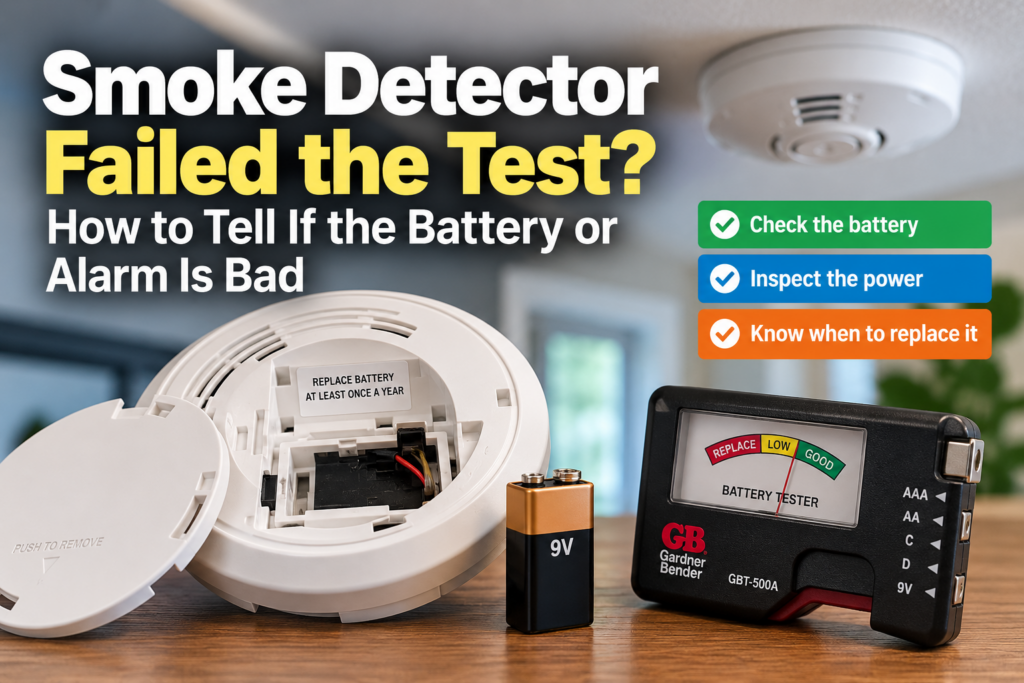
Nothing happens.
Or perhaps it makes a weak noise that sounds nothing like the ear-piercing alarm you expected.
Do not ignore that.
A smoke alarm that does not respond normally when tested needs to be investigated immediately.
The problem might be simple:
- a dead battery;
- a battery installed incorrectly;
- a battery activation tab that was never removed;
- or a hardwired alarm that is not receiving power.
But there is another common possibility:
The smoke detector itself may be finished.
Smoke alarms do not last forever. The U.S. Fire Administration recommends replacing smoke alarms 10 years from their manufacture date, and manufacturers similarly warn that a unit that still fails its test after basic troubleshooting may need replacement. It is why you should write the install date on the detector itself.
Here is how I would figure out which problem you have.
Quick Answer: What Should You Do If a Smoke Detector Fails the Test?
- Make sure you are using the test button correctly. Some alarms require you to hold it for several seconds.
- If the alarm has a replaceable battery, install a fresh battery in the correct orientation.
- Test it again.
- If it is hardwired, confirm that the unit is properly connected and receiving power according to the manufacturer’s instructions.
- Check the manufacture date on the back of the alarm.
- If the alarm is around 10 years old—or still will not sound after correcting the battery or power problem—replace the alarm.
If there is actual smoke, a burning smell or any reason to believe there may be a fire, do not spend time troubleshooting the detector. Get everyone out and treat it as an emergency.
First: Make Sure You Are Actually Testing It Correctly
The TEST button is the manufacturer’s built-in functional test.
Depending on the model, you may need to hold the button for several seconds before the alarm sounds.
Kidde, for example, instructs users of many smoke alarms to hold the test button for at least five seconds.
A normal test should produce a loud alarm pattern.
If your alarms are interconnected, the test may also cause the other connected alarms in the house to sound.
If you pushed the button very briefly and nothing happened, try again using the procedure in the manual for your specific model.
If it still remains silent or sounds weak, continue troubleshooting.
A Status Light Does Not Prove the Alarm Is Working
This is an easy mistake to make with a hardwired alarm.
You see a green power light and assume everything is fine.
Not necessarily.
The light can tell you that the unit is receiving power. It does not replace a functional test of the alarm.
Kidde specifically warns that the status indicator alone does not prove the alarm is working and recommends using the test button.
If the light is on but the alarm will not respond normally to the TEST button, investigate the problem rather than trusting the light.
If the Smoke Detector Has a Replaceable Battery
This is the easiest version to troubleshoot.
1. Check the Battery Orientation
Remove the battery and make sure the positive and negative terminals are installed exactly as indicated inside the battery compartment.
This sounds embarrassingly obvious.
It is still worth checking.
Some alarms also have battery-retaining tabs or mechanisms that prevent the compartment from closing correctly when the battery is not seated properly.
2. Install a Known Fresh Battery
If there is any question about the battery, replace it with a fresh battery of the type specified by the alarm manufacturer.
Then test the alarm again.
If the alarm now sounds normally, the old battery was probably the problem.
3. Test the Removed Battery Separately
If you want to know whether the old battery was actually dead, a simple household battery tester is useful.
I like this better than trying to infer battery condition from how long the battery has been installed.
The Gardner Bender GBT-500A is a simple analog tester that handles common household batteries from 1.5V through 22.5V, including:
- AAA;
- AA;
- C;
- D;
- 9V rectangular batteries;
- button cells;
- 3V lithium cells;
- and several less common battery types.
It has dedicated contacts for quick 9V testing and a simple color-coded Good/Replace scale rather than requiring you to interpret a raw voltage reading.
Check the Gardner Bender GBT-500A battery tester on Amazon
A battery tester is useful for the drawer full of AA, AAA and 9V batteries that somehow accumulates in every house too.
But for smoke-alarm safety, I would not try to squeeze another few months out of a questionable inexpensive battery.
If you are unsure, replace it.
What If a Fresh Battery Does Not Fix It?
This is the important fork in the road.
If you install a fresh battery correctly and the smoke alarm still will not make a proper test sound, the problem may be the alarm rather than the battery.
Before replacing it, check:
- whether the battery contacts appear damaged or corroded;
- whether the battery compartment is closing completely;
- whether the alarm requires a reset procedure;
- and how old the alarm is.
Follow the troubleshooting procedure in the manual for your exact model.
If the unit still does not test correctly, replace it.
A smoke detector is not an appliance I would keep using while hoping it sorts itself out.
Check the Manufacture Date
Remove the alarm from its mounting plate far enough to read the label on the back.
You are looking for the manufacture date, not the date when you happened to move into the house.
The U.S. Fire Administration recommends replacing smoke alarms 10 years from the manufacture date.
So if the back of your detector says:
Manufactured: September 2016
and you are reading this in September 2026, I would not spend much time trying to revive it.
It has reached the end of the normal replacement interval.
Replace the alarm.
What If You Don’t Know How Old the Detector Is?
Check the label.
If there is no readable manufacture date and you cannot determine the age of the alarm, that is another reason to consider replacement—particularly if the unit is already failing a functional test.
A smoke alarm that came with the house may be much older than it looks from the outside.
What If It Has a Sealed 10-Year Battery?
Do not go hunting for a battery door that does not exist.
Many current smoke detectors have a sealed lithium battery intended to remain inside the alarm for its service life. In fact, in some places they no longer permit the older replaceable ones.
You cannot take that internal battery out and put it on the Gardner Bender tester.
You test the alarm itself.
If a sealed-battery alarm:
- fails its test;
- is giving an end-of-life warning;
- or has reached the end of its specified service life;
the normal solution is replacement of the entire alarm.
This is also why changing the battery does not solve every chirping problem.
If that is the problem you are having, see our guide to why a smoke detector keeps chirping even after you replace the battery.
What If the Smoke Detector Is Hardwired?
A hardwired detector adds another layer because it can receive AC power from the house while also having some form of backup battery.
If the alarm will not test:
- check the power indicator;
- make sure the alarm’s wiring connector is fully seated if the manufacturer instructs you to inspect it;
- check whether other alarms on the interconnected system are operating;
- and follow the testing procedure for the exact model.
Some hardwired alarms have a conventional replaceable backup battery.
Others have a sealed backup battery.
Do not assume every hardwired alarm has a removable 9V battery hidden somewhere inside.
Does Pressing TEST Prove the Backup Battery Works?
Be careful here.
The test button is the correct functional test for the alarm, but the exact procedure matters when you specifically want to verify a hardwired alarm’s backup battery.
Some manufacturers instruct users of particular hardwired models with replaceable backup batteries to disconnect the alarm from AC power and test it while operating on battery before reinstalling it.
Follow the instructions for your exact model.
Do not alter household electrical wiring or improvise your own test procedure.
If you are unsure how a hardwired alarm should be tested or connected, consult the manufacturer or a qualified electrician.
What If the Alarm Makes a Weak Sound?
A weak, abnormal or intermittent test sound should not be treated as a pass.
Try a fresh replaceable battery if the unit uses one.
Then test again.
If the sound remains abnormal, check the alarm’s age and manufacturer troubleshooting instructions.
If the unit is old or still cannot produce its normal test alarm, replace it.
What If the Test Works but the Alarm Keeps Chirping?
A successful test and a chirping alarm can occur at the same time.
Chirping can indicate:
- a low battery;
- an incorrectly installed battery;
- a power interruption;
- a reset issue;
- or an end-of-life warning.
With sealed 10-year alarms, an end-of-life chirp can mean that the entire detector needs replacement.
See our smoke-detector chirping troubleshooting guide if that is your problem.
What If the Test Button Works but the Detector Is 10 Years Old?
Replace it.
This is another common misconception.
A successful button test does not make an old smoke alarm immortal.
The U.S. Fire Administration recommends replacing smoke alarms every 10 years.
The test button tells you that the alarm can complete its built-in test at that moment.
It does not cancel the recommended service-life limit. Beyond that, do you really want to take the risk?
When I Would Stop Troubleshooting and Replace the Alarm
I would replace the detector if:
- it is approximately 10 years old;
- it still fails the test after installing a fresh battery correctly;
- it has a sealed battery and is giving an end-of-life warning;
- it produces an abnormal test sound after basic troubleshooting;
- it is physically damaged;
- or the manufacturer says its service life has ended.
If you have reached that point, see our current guide to the best smoke and carbon monoxide detectors.
There are now meaningful choices between:
- hardwired and battery-only alarms;
- replaceable and sealed batteries;
- smoke-only and combination smoke/CO detectors;
- voice alerts;
- interconnected systems;
- and smart alarms.
You do not necessarily need the most expensive detector.
You do need one you can trust.
Battery Bad or Smoke Detector Bad? A Quick Decision Table
| What Happens | What I Would Check |
|---|---|
| No sound when TEST is pressed | Testing procedure, battery installation, power, age of alarm |
| Works after installing a fresh battery | Old battery was likely the problem |
| Still silent with a fresh battery | Alarm failure or other fault; follow manufacturer guidance and replace if unresolved |
| Green light is on but no test sound | Do not rely on the power light; troubleshoot the alarm |
| Sealed 10-year alarm fails test | Check age and manufacturer instructions; replacement may be required |
| New battery but still chirping | Reset procedure, age and end-of-life warning |
| Alarm is 10 years old | Replace the alarm |
| Several alarms fail or chirp together | Check their manufacture dates and interconnected system |
Do Not Test a Smoke Alarm With an Open Flame
Do not hold a match, lighter or candle under a smoke detector to see whether it works.
Kidde specifically warns against testing a smoke alarm with an open flame because you can damage the alarm or start a fire.
Use the manufacturer’s test button and any other testing method specifically recommended for your model.
How Often Should You Test Smoke Alarms?
The U.S. Fire Administration recommends testing smoke alarms at least once a month using the test button.
That includes:
- battery-operated alarms;
- hardwired alarms;
- and sealed long-life alarms.
You should also pay attention after:
- changing a battery;
- a power outage;
- removing and reinstalling an alarm;
- or any situation that gives you reason to question whether it is operating normally.
Frequently Asked Questions
Why doesn’t my smoke detector beep when I press the test button?
The battery may be dead or installed incorrectly, the alarm may not be receiving power, you may need to hold the test button longer, or the detector itself may have failed. Check the manufacturer’s instructions, install a fresh battery if applicable and check the age of the alarm.
What if I put in a new battery and the smoke detector still doesn’t work?
Confirm the battery is installed correctly and follow the manufacturer’s troubleshooting procedure. If the alarm still will not test normally, particularly if it is approaching 10 years old, replace it.
Can I test a smoke detector battery with a battery tester?
You can test a removable 9V, AA, AAA or other compatible battery separately with a battery tester. That does not replace testing the smoke alarm itself with its TEST button.
What battery tester can I use for a 9V smoke-detector battery?
The Gardner Bender GBT-500A has dedicated contacts for 9V batteries and also tests many other common household battery sizes.
Does a green light mean my hardwired smoke detector works?
No. The light can indicate that the alarm is receiving power, but you should still perform the manufacturer’s functional test using the TEST button.
Should I replace a smoke detector that still works after 10 years?
Yes. The U.S. Fire Administration recommends replacing smoke alarms 10 years after their manufacture date.
Can you replace the battery in a 10-year sealed smoke detector?
Normally no. The battery is designed to remain sealed inside the alarm. When the alarm reaches the end of its service life or fails, the entire alarm is replaced.
Why does my smoke detector still chirp after I put in a new battery?
The problem may be a reset issue, power problem or end-of-life warning rather than a low replaceable battery. Older and sealed-battery alarms frequently need the entire detector replaced once they reach end of life.
A Failed Smoke-Alarm Test Needs an Answer
If you press TEST and nothing happens, don’t shrug and walk away.
First determine whether the problem is the battery.
Install a fresh battery if the alarm uses one.
If you are curious about the removed battery, a simple battery tester can tell you whether it still has useful charge.
Then test the alarm again.
If it still does not work, check its age and the manufacturer’s troubleshooting instructions.
If the alarm is around 10 years old or still fails its functional test, replace it.
A dead battery costs a few dollars.
A failed smoke detector is not something worth gambling on.
If you are starting one step earlier, see our guide to how to test a smoke detector battery correctly. If your alarm is chirping rather than failing silently, see why a smoke detector can keep chirping after a new battery.