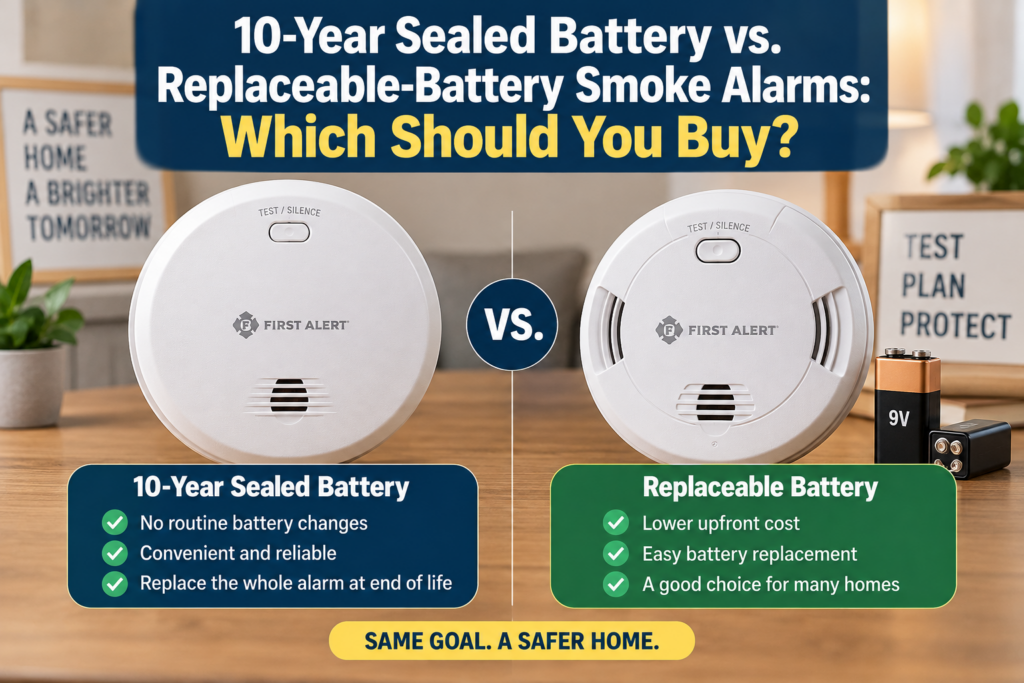
Do you buy a traditional smoke alarm with a battery you replace yourself?
Or do you buy one with a sealed battery designed to last for the life of the alarm?
For a simple battery-powered smoke alarm, I generally prefer the sealed-battery approach.
But it is not automatically the right answer for every house.
Replaceable batteries still have advantages. Hardwired systems complicate the question. And a label saying “10-year battery” does not mean you install the alarm and ignore it for a decade.
You still need to test it.
The alarm can still fail.
And when a sealed unit reaches the end of its life, you replace the entire alarm, not the battery.
Quick Answer: Sealed or Replaceable Battery?
If I were installing a new battery-only smoke alarm today, I would usually choose a quality 10-year sealed-battery model. Many governments have even mandated this.
The biggest advantage is simple:
There is no replaceable battery for someone to forget, remove or neglect.
That is particularly attractive for:
- vacation homes;
- rental properties;
- high ceilings;
- older relatives’ homes;
- and anywhere routine battery changes are likely to be forgotten.
I would still consider a replaceable-battery alarm when:
- upfront cost matters;
- I specifically want to be able to replace the battery myself;
- I already maintain my alarms on a regular schedule;
- or the correct alarm for an existing installation uses a replaceable battery.
If your home currently has hardwired interconnected alarms, do not replace them with independent battery-only alarms merely because sealed batteries are convenient. Use equipment appropriate for the existing system and applicable local requirements.
Two Current Examples
First Alert currently sells smoke alarms using both approaches.
First Alert SM210: Sealed 10-Year Battery
The First Alert SM210 is a battery-powered photoelectric smoke alarm with a sealed lithium battery designed for a 10-year service life.
It also has:
- a slim profile;
- First Alert’s Precision Detection technology;
- an end-of-life warning;
- an 85 dB alarm;
- and compliance with the current UL 217 10th Edition standard.
The battery is not replaceable. When the alarm reaches end of life, you replace the alarm.
Check the First Alert SM210 on Amazon
First Alert SMI100: Replaceable 9V Battery
The First Alert SMI100 takes the traditional approach. It operates from a replaceable 9V alkaline battery.
It includes:
- an easy-access battery compartment;
- an end-of-life warning;
- First Alert’s Precision Detection technology;
- an 85 dB alarm;
- and a 10-year limited warranty.
The Amazon listing below is currently a two-pack.
Check the First Alert SMI100 two-pack on Amazon
These are useful examples of the two battery strategies, but they are not identical alarms with different batteries. The SM210 uses a photoelectric sensor, while the SMI100 uses an ionization sensor. So I would not use their prices or performance to claim that one battery design itself produces better smoke detection.
Sealed vs. Replaceable Battery Smoke Alarms
| Feature | 10-Year Sealed Battery | Replaceable Battery |
|---|---|---|
| Routine battery changes | Normally none | Required |
| Battery can be removed | No | Yes |
| Upfront cost | Often higher | Often lower |
| Future battery purchases | Normally none | Yes |
| Monthly testing | Still required | Still required |
| When battery reaches end of life | Replace alarm | Replace battery |
| Biggest advantage | Less maintenance | Easy battery replacement |
The Best Argument for a Sealed Alarm Is Human Behavior
Saving a few dollars on replacement batteries is nice.
That is not the main reason I like sealed alarms.
The real advantage is eliminating a common failure point:
the person responsible for changing the battery.
People forget.
They postpone it.
A detector begins chirping at 2 a.m., somebody removes the battery to stop the noise, and somehow the replacement never happens.
A sealed alarm removes that possibility.
There is no 9V battery to borrow for something else and no empty battery compartment that can quietly remain empty for months.
Why I Like Sealed Alarms for Vacation Homes
Vacation properties are an especially good use case.
If nobody lives in a house every day, routine maintenance is easier to miss.
It may also be hard to remember whether the battery was changed last spring, last fall or three years ago.
A sealed long-life alarm reduces that maintenance burden.
You should still:
- test the alarms regularly;
- check their manufacture dates;
- pay attention to fault and end-of-life signals;
- and replace any alarm that does not work properly.
Sealed does not mean maintenance-free.
It means there is one less maintenance task.
High Ceilings Are Another Good Use Case
Changing a battery is trivial when a detector is easily reached.
It becomes considerably more annoying when the alarm is above:
- a staircase;
- a vaulted ceiling;
- or another awkward location.
If a battery change requires a large ladder every year, reducing routine battery replacement has real value.
You still need safe access to test and eventually replace the alarm.
Can a 10-Year Smoke Alarm Still Chirp?
Absolutely.
The sealed battery eliminates the familiar annual low-battery replacement cycle.
It does not eliminate every warning an alarm can produce.
A sealed alarm may chirp or otherwise alert you because of:
- a fault;
- an end-of-life condition;
- or another problem defined by the manufacturer.
Eventually an end-of-life warning is expected.
At that point, the answer is generally to replace the alarm rather than hunt for a battery compartment that does not exist.
If you are already fighting this problem, see our guide to why smoke detectors can keep chirping even after a battery replacement.
Does a 10-Year Battery Definitely Last 10 Years?
I would not interpret “10-year battery” as an unconditional guarantee that every individual alarm will work for precisely a decade. I’ve experienced many that have not.
The product is designed around a long-life battery and the expected service life of the alarm.
But electronics can fail.
Environmental conditions matter.
If an alarm fails after six years, you do not leave it on the ceiling for another four because the package said “10-year.”
You replace a failed alarm.
You Still Have to Test a Sealed Alarm
This is the most important misconception to avoid.
A sealed battery does not eliminate testing.
Smoke alarms should still be tested regularly using their built-in TEST button.
That applies whether the alarm uses:
- a replaceable 9V battery;
- AA batteries;
- a sealed lithium battery;
- or household AC power with a backup battery.
Our guide to testing a smoke detector battery correctly explains why the test button and battery condition are related but not exactly the same question.
The Advantage of a Replaceable Battery: You Can Replace It
There is something appealingly simple about the traditional approach.
Battery gets weak.
Open the compartment.
Install another one.
Test the alarm.
Done.
If the battery itself fails prematurely, you do not discard the whole smoke detector.
And if you are disciplined about testing and maintenance, a replaceable-battery smoke alarm is perfectly practical.
Replaceable-Battery Alarms Can Cost Less Up Front
If you are buying eight or ten smoke detectors at once, even a modest difference in price per alarm can add up.
That makes inexpensive replaceable-battery models attractive.
The First Alert SMI100 two-pack, for example, gives you two conventional battery-powered detectors in one purchase.
But remember to include future batteries in the economics.
A replaceable-battery alarm may cost less today while requiring multiple batteries during its service life.
I would not make a safety-equipment decision over a tiny long-term price difference, but the sealed model’s higher initial price does buy convenience.
What About Hardwired Smoke Alarms?
This is where the comparison becomes more complicated.
A hardwired smoke alarm receives power from the house and generally uses a backup battery.
Modern hardwired alarms may have:
- a replaceable backup battery;
- or a sealed backup battery.
If your house already has interconnected hardwired alarms, I would normally replace them with compatible hardwired equipment rather than switching to stand-alone battery models.
Interconnection is valuable because one alarm detecting smoke can cause other interconnected alarms around the house to sound.
Do Not Assume Every Hardwired Alarm Is Plug-Compatible
Two smoke alarms may look nearly identical from the room while using different wiring connectors behind the mounting plate.
When replacing a hardwired alarm, check:
- manufacturer;
- model;
- connector;
- interconnection compatibility;
- and any approved adapter requirements.
Do not improvise household wiring simply to make a detector fit.
What About Smoke and Carbon Monoxide Combination Alarms?
You can also find both battery approaches in combination smoke-and-CO alarms.
These can reduce the number of separate devices you need, although you should pay attention to the manufacturer’s replacement interval and the requirements for proper placement.
If you are replacing several alarms throughout a house, see our guide to the best smoke and carbon monoxide detectors.
Which Would I Buy?
For a new battery-only smoke-alarm installation, I would generally buy the sealed model.
A current example is the First Alert SM210.
I particularly like the sealed approach for:
- vacation homes;
- rental properties;
- hard-to-reach locations;
- and homes where routine maintenance is likely to get forgotten.
I would choose a replaceable-battery model when I specifically wanted easy battery replacement or wanted to minimize the initial cost.
The First Alert SMI100 is a straightforward current example.
Frequently Asked Questions
Are 10-year sealed smoke detectors better?
They are more convenient because they eliminate routine battery replacement and make it much harder for someone to leave the alarm without a battery. They still require regular testing and eventual replacement.
Can you replace the battery in a sealed smoke detector?
Normally no. The internal battery is not designed for routine replacement. When the alarm reaches end of life or develops an unrecoverable fault, the entire alarm is replaced.
Do sealed smoke alarms still chirp?
Yes. They can produce fault or end-of-life warnings even though there is no removable low battery to replace.
Do you still have to test a 10-year smoke detector?
Yes. A long-life battery does not remove the need to regularly test the alarm with its TEST button.
Is a replaceable-battery smoke detector unsafe?
No. A properly installed and maintained replaceable-battery alarm can work perfectly well. The disadvantage is that it depends on somebody keeping a working battery installed.
Does the First Alert SM210 have a replaceable battery?
No. The SM210 uses a sealed lithium battery designed around a 10-year service life.
What battery does the First Alert SMI100 use?
The SMI100 uses one replaceable 9V alkaline battery.
Is the SM210 the same alarm as the SMI100 except for the battery?
No. They also use different smoke-sensing technologies: the SM210 is photoelectric while the SMI100 is ionization. They are useful examples of the two battery approaches, but they should not be treated as otherwise identical products.
My Preference Is Simple: Remove One Thing That Can Be Forgotten
A replaceable-battery smoke alarm can do its job perfectly well.
My preference for a sealed alarm is mostly about human behavior.
There is no annual battery replacement to remember.
There is no battery to remove because the alarm started chirping in the middle of the night.
There is no empty compartment waiting for somebody to remember to buy another 9V battery.
You still need to test the alarm.
You still need to respond if it reports a fault.
And you still need to replace it when its service life is over.
But eliminating one recurring maintenance task seems worthwhile to me.
For a straightforward new battery-powered installation, I would generally choose the sealed First Alert SM210.
If I specifically wanted replaceable batteries or a lower-cost conventional design, I would look at the First Alert SMI100 two-pack.
And whichever type you buy, put it on the ceiling and test it.
A slightly less sophisticated smoke alarm that is installed and working is much more useful than the perfect one still sitting in an Amazon box.