Gadget Wisdom

0 Responses

Digital Content: Do you really own it? Shouldn’t you?

A U.S. book and its licensed Chinese page by p...
Image via Wikipedia

Earlier, while writing the first installment of our new series, Downstreaming, the issue of digital content ownership came into play. After all, we don’t own digital content, we own a license for it. If you buy a DVD, you own it. If you buy a book, you own it. The fact that we don’t own our content is somewhat disturbing.

Let’s take the Kindle license agreement. The Kindle, of course, was a top seller in 2010. Here is the Kindle license.

Upon your download of Digital Content and payment of any applicable fees (including applicable taxes), the Content Provider grants you a non-exclusive right to view, use, and display such Digital Content an unlimited number of times, solely on the Kindle or a Reading Application or as otherwise permitted as part of the Service, solely on the number of Kindles or Other Devices specified in the Kindle Store, and solely for your personal, non-commercial use. Unless otherwise specified, Digital Content is licensed, not sold, to you by the Content Provider. The Content Provider may post additional terms for Digital Content in the Kindle Store. Those terms will also apply, but this Agreement will govern in the event of a conflict.

So, we can view, use and display content. We do not, however, have a right to download such content in perpetuity, which makes one wonder what might happen if Amazon changes the configuration of the Kindle store someday in the future. Would the content we have work on the 20th generation Kindle?

The Nook store does not cover the issue in their terms of use.

Then there is Amazon VOD, which we discussed in this article. There, if your content becomes unavailable, even though you paid for it…you are just out of luck.

For other media services, the content is stored locally, but the license requires access to a server to authenticate. And those servers will not work in perpetuity. While we think that if you buy something, steps should be taken to ensure its continuity. Companies should advise you of how they plan to do that.

A recent Pew study found that 65% of users have paid for online content. On the media side of that:  33% was music, 18% was newspaper or journal content, and 16% were movies or TV shows. The average expense being $47 per month for material downloaded or accessed overall, be it subscription(23%) or individual file access(16%) or accessing streaming content(8%).

These numbers will only be going up and these questions should be answered by companies. But they likely won’t any time soon. Companies would prefer that online, rental prevails, with no purchase. Why not make you repurchase something you’ve already bought before with no value-added…just a chance to continue to make money off their property?

It is why, despite our love of technology, physical books and physical copies of media are unlikely to die any time soon. As long as companies can rescind our ability to use something we’ve lawfully purchased, other pros and cons aside, they are not going anywhere.

Published on January 1, 2011
Full Post
2 Responses

Downstreaming: Amazon Video on Demand

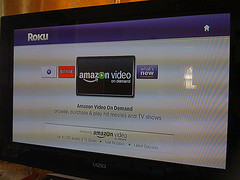
Amazon VOD on Roku
Image by programwitch via Flickr

For the first installment of Downstreaming, we’re going to explore Amazon Video On Demand as an option for acquiring content.

Amazon Video on Demand, formerly known as Amazon Unbox, is Amazon’s video streaming service. It is not subscription based. It is an ala-carte video service that offers both rental and purchase. You can also purchase passes to TV shows and receive a discount.

Amazon VOD support is built into the Roku Box, Google TV, Tivo, and select televisions and blu-ray players. You can also stream it using Adobe Flash on a computer. It offers both SD and HD rentals. We’re just waiting for an HTML5 version, and iOS and Android apps for the mobile platforms.

We decided to give it a shot, taking advantage of an offer for the popular movie Inception for 99 cents for a 48 hour rental. It included a $4 credit if we choose to buy the movie afterward. Video acceleration on the Linux version of  Adobe Flash can sometimes lag a bit, so we used a Roku Box to test the service. The movie playback was great, and there is a good selection of daily/weekly/monthly deals and some free content.

One of the nicest value added additions Amazon VOD offers is Disc+ On Demand. This is an Amazon program for those who purchase physical media. On select discs, you will automatically get a digital version of your purchased movie in your Amazon Video on Demand library. The problem is, so far, in movies we’ve bought, this is a limited time rental. We think many people would pay extra for a movie, or a premium to get disc plus digital copy provided by Amazon VOD.

Many movies are now being bundled with a digital copy that is time limited. An Amazon VOD redemption option with each movie seems like a better idea for studios, even if it is only a discount on getting the streaming copy. Teleread, for example, recently commented on how the code to use the digital copy included with the latest Star Trek movie expired…before they had purchased the movie. Yet the discs are still being bundled. The issue with buying content…excuse us…licensing content that is stored in the cloud is if the service provider ceases to provide the service. Then…what do you own?

Amazon VOD, in their terms of service, states, “Purchased Digital Content will generally continue to be available to you for download or streaming from the Service, as applicable, but may become unavailable due to potential content provider licensing restrictions and for other reasons, and Amazon will not be liable to you if purchased Digital Content becomes unavailable for further download or streaming.” We would feel more comfortable if, like their Kindle scandal a while back, Amazon was forced to ensure that even if they can no longer sell an item, that anyone who purchased it is still entitled to enjoy it in perpetuity, as the term “Buy” implies. But, for rentals, the service is a good alternative.

Published on January 1, 2011
Full Post
0 Responses

Downstreaming: Cutting out Cable

Motorola DCT 6412 Phase 2 digital/analogue cab...
Image via Wikipedia

Tomorrow, January 1st, 2010, the nice people at our cable company have opted to give us a holiday present….a rate hike. Everything is going up. When they are done, the monthly rental on an extra cable box will be $14.50. That includes 50 cents for a remote. We tried a few years ago to return the remote, use our own $10 one, and save 50 cents. Apparently, even though they keep giving us extra remote controls we don’t need, they can’t be returned for money.

Can a cable box purchased possibly cost more than what it is costing us to rent it? It is one thing to charge more for cable service, but for the box? That said, let’s move on to cable service itself. At least cable companies can claim that they are passing on the increased costs content providers are charging them. But in the end, the price is getting ridiculous.

We don’t want 90% of the channels we are paying for, but due to bundling, we are getting and paying for them. That is why, despite cord cutting is a hassle, and many have said they cannot live with it and come back, it keeps seeming like an option. There is so much free content out there, and so much reasonably priced paid content out there, is it any surprise that cable subscriptions are down.

But we’re not planning to go cold turkey. That is how most cord cutters fail. We want to gradually wean ourselves off of these services, and explore alternatives. It may mean we have to wait for content. Is the latest episode of a popular show so timely it can’t be watched a day or a week later, which is when some online services receive it?

That said, cable is not likely to leave our households any time soon. But bringing down the cable bill is a serious concern. This includes looking at fewer cable boxes, lower levels of service, and more MythTV frontends, streaming boxes, etc. There are pitfalls. It means investment of time and money in experimentation. But that is better than thousands spent on cable television each year.

We needed a name for this multi-part series about experiments in cord cutting. Downstreaming seemed good as any. Stay tuned….

Published on December 31, 2010
Full Post
1 Response

My Kodachrome Has Been Taken Away

Eastman Kodak Kodachrome 64 Films
Image via Wikipedia

The oldest color camera film ever made will fade into the history books on December 30th as the last laboratory in the world that processes the film runs out of the chemicals to develop it. The film has been used to capture many of the most iconic color images of the twentieth century. When Abraham Zapruder filmed the Kennedy Assassination, he used Kodachrome.

Kodachrome was the first commercially successful color film, and has been in production for 74 years. Kodak will not be producing any more as they consider it to be no longer viable. Dwayne’s Photo in Parsons, Kansas, the last laboratory, still processes 700 rolls each day, but will grind to a halt abruptly this week. “The real difference between Kodachrome and all the other colour films is that the dyes that make up the image you see in the film, in Kodachrome, don’t get incorporated into the film until it is actually developed,” said Grant Steinie, who runs the laboratory.

Kodachrome was appreciated by professionals for its vibrant colors and accuracy as well as its storage longevity. The final roll of Kodachrome manufactured was used by photographer Steve McCurry of National Geographic fame and processed in July. You can track the countdown to the end of Kodachrome at the Kodachrome Blog at kodachromeproject.org, a site for Kodachrome enthusiasts.

A Tribute to Kodachrome by Kodak

We have a box of kodachrome slides sitting here that we plan to someday get around to cleaning and running through a slide scanner. And while the age of digital photography is here, there is something to be said about what can be capture on traditional film, even if subsequently digitized…something that is lost now.

Rest in Peace, Kodachrome – 1935-2010 – Paul Simon Sang About It, a State Park was named after It, National Geographic Shot Their Most Famous Photos On It, and now they have taken our Kodachrome away.

Published on December 26, 2010
Full Post
0 Responses

XBMC Version 10 Now Available

XBMC Screen
Image via Wikipedia

Version 10 of XBMC Media Center, the popular cross-platform media software, was released.

The focus of this new release is add-ons. The new add-ons system allows you to install add-ons such as themes and plugins directly from within the program. In addition, the release offers improved hardware acceleration and more.

If you are interested in giving it a try, why not download the Live CD, which will let you try it without installing.

Download it today.

Published on December 20, 2010
Full Post
0 Responses

When The Cloud Fails You – Delicious and More

Image representing delicious as depicted in Cr...
Image via CrunchBase

This year, many services we have grown used to have started to announce shutdowns. Most notably, a news story reporting that Yahoo was shutting down Delicious caused many to scramble to find other services.

It turned out Yahoo is looking to sell Delicious, not to merely discontinue it. But it does mean that unless someone wishes to acquire the service, it will be shut down eventually. Delicious is a social bookmarking site.

Pinboard, for example, after the news, gained many new users, and gained seven million bookmarks with it, more than they’d collected over the lifetime of their service.

But that isn’t quite the point. The point is to not keep all your eggs in one basket. Cloud storage is great. We all use it, and love it. But be prepared. Periodically export your data and keep a copy elsewhere. There are also services. Paid services are also available, such as Backupify.

Backupify has an impressive collection of backup tools for GMail, Twitter, Facebook, etc. You may not wish to pay. But remember, you should have at least two backups, and at least one of them should be offsite…not in the same place you keep the primary storage. More on this to come.

Published on December 19, 2010
Full Post
0 Responses

LastPass Acquires Xmarks

Image representing LastPass as depicted in Cru...
Image via CrunchBase

The title says it all. LastPass, which is a cross-platform password manager, has acquired Xmarks, a cross platform bookmark, tab, history, and password sync. It seems a match made in heaven. The two businesses seem to align perfectly.

Xmarks will join Lastpass‘s Freemium model. The browser plugin and most of what users are used to will remain, but new features will be available, including an iPhone and Android app. Those features will be part of the $12 a year premium package. You can get both premium services bundled for a $20 a year package.

The two services will continue to require separate downloads and will be administered through two distinct extensions and websites, although there are plans to integrate them in the future.

Published on December 5, 2010
Full Post
0 Responses

Amazon Follows the Gift of Literature with the Gift of Music

Amazon mp3
Image by Greg Palmer via Flickr

Hot on the heels of gifting Kindle books, Amazon has arranged for the ability to gift an MP3 from the Amazon. Like the Kindle book gifting, it is keyed to one’s email address, and can be exchanged for store credit.

These gifting features are not complicated. But as Dilbert once pointed out, a gift certificate is worse than cash, because you can only use it in one place. You’re trading perfectly good money for something that does the same thing, only not as well. But the ability to gift a specific item shows some thought toward the wants and desires of the one receiving the gift, but they can still exchange it if they do not like it.

Published on November 28, 2010
Full Post
0 Responses

Back to the Toilet Technology

toilet wc
Image via Wikipedia

In June, we reviewed the MJSI HydroRight Dual Flush converter, and discussed the principles of toilet technology. Amazon has some good deals on two pieces of MJSI technology. One is, of course, the Dual Flush Converter. The other is the HydroClean Water-Saving toilet Fill Valve.

[asa]B000L87RKC[/asa]

So, we already know that the HydroRight Dual Flush converter is a drop-in converter to turn your toilet into a water-saving dual flush. Of course, you need a concentric-float toilet fill valve, and that is where the HydroClean valve comes in as a perfect pair to the HydroRight.

The water-saving advantages of the HyroClean are that it is adjustable, and allows you to not waste water in your flush, so even if you are reluctant to go Dual Flush, this will limit wasted water per flush. It even has a cleaning tube to clean the gunk off the bottom of your tank.

[asa]B002NKRR7Y[/asa]

We’re thinking of pairing this with our HydroRight in order to improve water efficiency, as we still think we are wasting water on our toilet. Best of all, it is not an expensive improvement.

And it is now legal in New York City, as we discovered it wasn’t when we originally installed it.

Published on November 28, 2010
Full Post
0 Responses

HDHomeRun to Start Preorder in December

SiliconDust HD HomeRun (HDHR) network dual-tun...
Image via Wikipedia

The Digital Media Zone reports that the SiliconDust HDHomerun Prime will be released to production in two weeks, shortly after which pre-order and release dates will be announced. The HDHomerun Prime is a three-tuner cablecard ready networked tuner. The price will be $249.

This, coupled with the fact that Copy Freely material may now be used by Linux devices, and that SiliconDust has long worked with MythTv developers, makes us potentially excited.

Published on November 25, 2010
Full Post

Get New Posts By Email